Robot training work
AV and Drone Operator Work
Based on 84 different posted rates, from 19 employers. 427 of these 550 openings give no hourly figure. Advertised USD hourly sample only, not a representative wage survey. Missing rates may bias the result in either direction.
AV & Drone roles open now
Updated 1 Nov 2026, 06:01 UTCSome links here are referral links: when you join an employer through one, RobotTraining.jobs may receive a commission. It costs you nothing, and the employer pays you exactly the same.

Drone Pilot, Flight Testing (opens the job details)
Aerospace engineering firm · Englewood, Colorado, United States· 2d agoDetails

Flight Monitor (opens the job details)
Amazon Prime Air · Pooler, Georgia, USA· 2d agoDetails
$35/hr
 $33/hr

Driver Trainer/Auditor 2 (opens the job details)
Torc Robotics · Fort Worth, Texas· 1w agoDetails
$101,500–$121,800/yr

Truck Operations Specialist (opens the job details)
Aurora Innovation · Midland, TX, United States· 1w agoDetails
$31.00–$38.50/hr
UAS Pilot/Flight Test & Mission Operator (opens the job details)
CHAOS Industries · El Segundo, California, United States· 1w agoDetails
$130,000–$180,000/yr $25–$29/hr

Operate autonomous vehicles and drones as a human in the loop: in-vehicle safety drivers and remote AV operators who monitor, intervene, and generate the edge-case data self-driving systems train on, and Part 107 drone pilots flying data-collection missions. A large, established on-ramp into embodied-AI work with test fleets hiring in specific cities.
How contested these jobs are
From 4 Oct 2026 to 31 Oct 2026, AV & Drone Operators roles drew 10.3% of the apply clicks on RobotTraining.jobs while making up 47.7% of the time roles were open, so each opening drew 0.22x the attention of an average role. Fewer people chase each opening than in most kinds of work, so a fitting application stands out more easily.
Measured from apply clicks on this site, not from hires. Every kind of work compared.
AV & Drone alerts
Get new AV & Drone roles by email
Each week we gather the latest paid AV & Drone openings from every employer we follow, with the hourly rate where it is posted, and send them in one email. No cost, and you can stop any time.
Only job openings, nothing else. Unsubscribing takes one click.
What AV & drone jobs pay, by job title
In short
AV & Drone Operators. Operate autonomous vehicles and drones as a human in the loop: in-vehicle safety drivers and remote AV operators who monitor, intervene, and generate the edge-case data self-driving systems train on, and Part 107 drone pilots flying data-collection missions. Typical 2026 pay is $25–$50/hr. The live median is $30/hr, taken from the 19 employers posting a rate for it today. Hiring for it: 52 employers, among them Saildrone, Saronic, Kodiak AI.
The job, up close
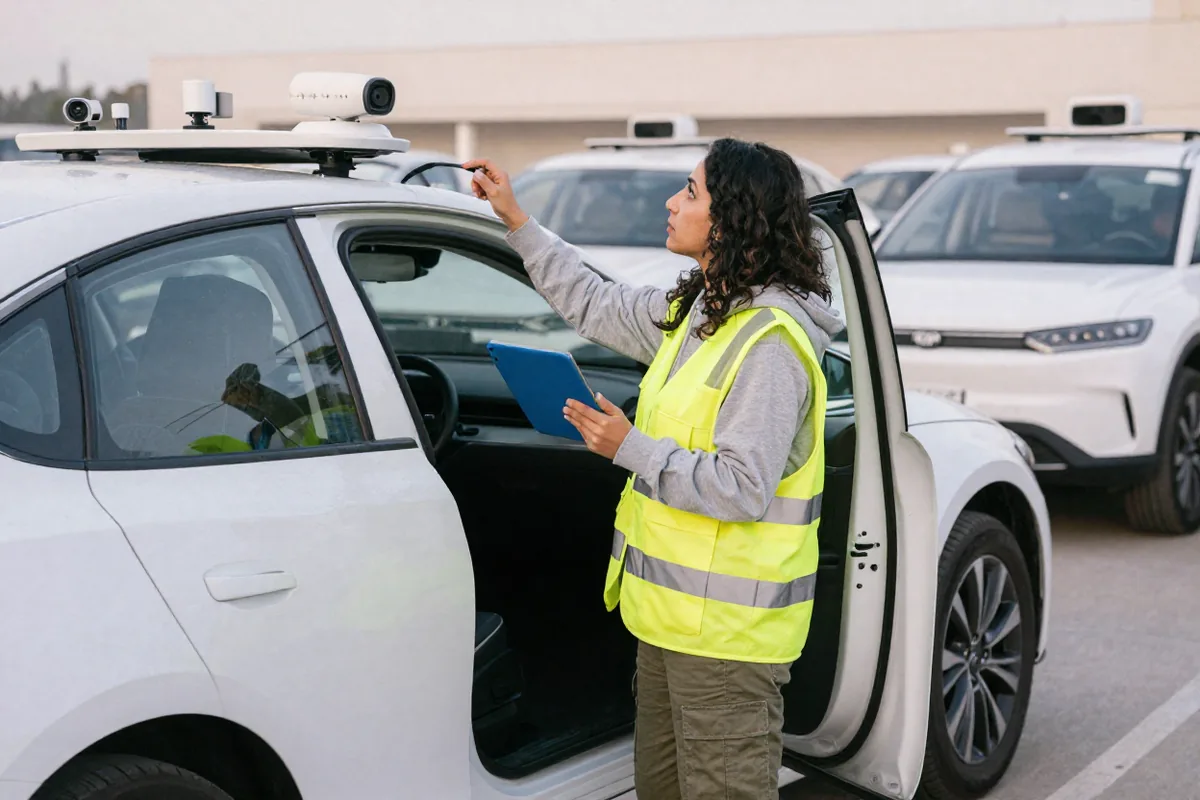
Operate vehicles & drones
Supervise an autonomous test vehicle or fly a drone on a data-collection mission, following the project’s operating procedures.
- A sample task
- Fly a planned drone capture route or monitor a self-driving vehicle as its safety operator.
- Workplace
- Test routes, vehicle depots, or outdoor flight areas
- Tools and kit
- Vehicle controls or a drone controller; role-specific qualifications may apply
Employers hiring for AV & drone



































Sorted by what an application there is likely worth to you, with a referral lift for employers that pay us a referral fee; your pay is never affected.
Want more context? Line up AV & drone pay at every employer in the pay explorer.
A clean driving record or a drone certificate?
Fill in a single profile and any robot training employer can reach you through us. When a company needs someone in a certain city or country, or holding a license or certificate, and you fit, we put you forward, but only after you say yes. It costs nothing.
Written by Yuma Heymans, Founder & CEO of RobotTraining.jobs.
Runs RobotTraining.jobs and AITraining.jobs as founder and CEO, and co-founded HeroHunt.ai, an AI recruitment platform. San Francisco based, and for years focused on how the people who teach robots and AI systems are found, hired and paid.
AV and drone operators support autonomous systems through monitored driving, flight testing and data-collection missions.
What the work actually is
There are three distinct jobs under this heading, and they attract different people.
In-vehicle safety driver / AV test operator. You sit behind the wheel of a self-driving car or truck during on-road and closed-course testing. Your job is to stay alert through long stretches of autonomy, take manual control the instant the system needs it, and log detailed feedback on how the vehicle behaved. This is the classic entry role at robotaxi and autonomous-trucking programs. On the trucking side ( Aurora, Kodiak) it requires a commercial driver's license and is effectively a professional-driving job with a data-collection layer on top.
Remote AV / robot operator (teleassist). As fleets go driverless, the human moves out of the vehicle and into a remote operations center. Remote operators monitor several vehicles or delivery robots on screens and step in when one gets stuck: not joystick-driving it down the street, but approving a path or resolving an ambiguous situation. This is closely related to robot fleet operations and teleoperation, and it is where a large part of the field is heading.
Part 107 drone pilot. On the aerial side, certified remote pilots fly drones on data-collection missions: mapping, inspection, surveying, agriculture, and capturing the aerial imagery and LiDAR that feeds perception and mapping models. The gate here is not a driving record but a federal certificate (details below).
Across all three, the underlying product is the same as the rest of embodied AI: your human judgment in edge cases becomes training and evaluation data. When you intervene, you are labeling, in real time, the exact situations the autonomy could not handle on its own.
What it pays
Read from today's open roles. 550 open roles on RobotTraining.jobs are in AV and drone operation, and 123 of them state an hourly rate. Those rates typically run $25 to $50 an hour, with a median of $30 an hour. They come from individual postings with different duties and locations, not from a category-wide wage survey; the pay explorer and pay report show the full measured sample and its coverage.
| Employer | Open roles | Of those, stating an hourly rate |
|---|---|---|
| All employers | 550 | 123 |
| TSMG | 298 | 1 |
| Tesla | 78 | 14 |
| Transdev | 25 | 25 |
| Amazon Prime Air | 17 | 16 |
| HireArt | 13 | 13 |
| Aurora Innovation | 9 | 9 |
| Gatik | 11 | 10 |
| Zipline | 8 | 5 |
| Kodiak AI | 6 | 5 |
| Nuro | 6 | 6 |
An advertised hourly amount is gross compensation, not verified take-home earnings. Salary, equity, benefits, overtime and contractor expenses must be compared separately. We do not infer what a beginner or an expert earns by splitting a pay distribution into tiers.
For accepted-footage or task payments, include setup, recording, upload, review and any rework in your time calculation. An hour of accepted video is a unit of output, not necessarily an hour of labor. There is no guaranteed volume of accepted tasks or paid hours.
Who is hiring and what you need to get in
For AV work, the requirement is a driving record, not a diploma. Employers ask for a valid license, typically 3+ years of driving experience and a clean record, often with no DUI or drug/alcohol offense in the last 5 to 7 years, plus strong situational awareness and the discipline to stay attentive through monotony. A high-school diploma is common; a college degree is not required. Autonomous-trucking operators ( Aurora, Kodiak) additionally need a Class-A CDL and must pass a DOT physical. The main employers running worker-facing operator programs are Waymo, Nuro, Zoox, Motional, May Mobility, Aurora, and Kodiak. Note that many of their hourly seats are filled through staffing agencies rather than posted directly on the corporate board.
How to get started
Start with the specific kind of operation you are qualified to perform. An in-vehicle safety role may require driving history and local work authorization; an autonomous-trucking role may require a commercial license. Read the individual posting before spending money on additional training.
For commercial drone work in the United States, check the FAA's remote-pilot requirements. A certificate alone does not establish that a vacancy involves AI training. Look for duties such as collecting development data, flight testing or evaluating autonomous behavior.
Before accepting an offer, confirm the work location, shift schedule, training arrangements and responsibility for equipment. Use the AV and drone learning guide to prepare questions for the employer.
The honest tradeoffs and outlook
The upside is real: this is legitimate, no-degree, hourly embodied-AI work you can start quickly, and it is a genuine door into the wider field. The tradeoffs are just as real. In-vehicle safety-driver roles are the ones most exposed to the technology maturing: as Waymo and others scale fully driverless service, the human moves from behind the wheel to a remote-assist desk, so the long-term growth is in remote operations and fleet teleassist more than in ride-along seats. Autonomous trucking, still in its safety-driver phase, keeps hiring CDL operators for now. On the aerial side the barrier to entry is low and the field is crowded: certification does not guarantee a contract. Check the mission requirements and available work before buying equipment.
The honest summary: AV and drone operating is one of the most accessible ways into embodied AI, it pays a fair hourly wage, and it teaches you how autonomous systems actually fail in the real world. Treat the entry roles as a launchpad. The workers who do best move toward the durable, higher-skill end of the field: remote operations, on-robot evaluation and QA, and specialized data capture. See where the pay leads across every category on RobotTraining.jobs's pay page.
Common questions
How much do autonomous vehicle operators make?
Pay is specific to the role, location and payment model, so read the posting. Today 123 of the 550 open AV and drone roles on this site's board state an hourly rate, and those rates typically run $25 to $50 an hour with a median of $30. That is the board's own measured band, not a market-wide wage survey; the pay explorer shows the full sample.
What do you need to become a Part 107 drone pilot, and what does it cost?
The FAA's remote pilot requirements are to be at least 16, able to read, speak, write and understand English, in a physical and mental condition to fly safely, and to pass the initial aeronautical knowledge exam at an FAA-approved testing center, followed by a TSA security background check. The certificate stays valid with online recurrent training every 24 calendar months. The exam is the main cost: testing centers set the fee, and one guide to the test puts it at $175. Many employers ask for more than the certificate, such as logged flight hours, so read the posting's own requirements first.
Do you need a college degree or special experience for this work?
No. AV operating requires a valid driver's license, usually 3+ years of driving experience, and a clean record (often no DUI or drug/alcohol offense in the last 5 to 7 years); a high-school diploma is common but a degree is not. Autonomous-trucking roles additionally require a Class-A CDL and a DOT physical. Drone work requires only the Part 107 certificate. In every case the real gate is reliability and a clean record, not credentials.
Is AV and drone operating going away as the technology improves?
The mix is shifting rather than disappearing. In-vehicle safety-driver roles are the most exposed: as robotaxi services scale fully driverless, the human moves from behind the wheel to a remote-assist desk, so growth is moving toward remote operations and fleet teleassist. Autonomous trucking is still in its safety-driver phase and keeps hiring CDL operators. On the drone side entry is easy and the field is crowded (the FAA counted over 493,000 certificated remote pilots in the US at the end of 2025), so the way to earn well is to specialize in a high-value mission type.
Which companies actually hire AV and drone operators?
For in-vehicle and remote AV operating: Waymo, Nuro, Zoox, Motional, May Mobility, Aurora, and Kodiak (Aurora and Kodiak for CDL trucking). Serve Robotics hires remote supervision and field operations staff for its delivery robots. Many hourly operator seats at these companies are filled through staffing agencies, so search both the official careers pages and staffing partners in your metro. Drone data-collection roles are hired by mapping, inspection, surveying, agriculture, and media firms once you hold a Part 107 certificate.
Sources
- Aurora: Truck Operations Specialist I (CDL-A) posting
- Built In: Serve Robotics compensation and benefits
- UAV Coach: Drone pilot salary 2026 (freelance rates)
- FAA: Become a Certificated Remote Pilot (Part 107 requirements)
- Rotate: Part 107 test cost and scheduling ($175)
- FAA: Certificated Remote Pilots including Commercial Operators
- FAA: UAS Compendium to the Aerospace Forecast 2026-2046 (remote pilot certifications, December 2025)
From the forum
Ask the people doing AV & Drone work what only they can tell you.
The research behind this page
The figures here come from the same daily read of employers' job boards, and from sourced datasets, that our research reports publish with their method, their sources and a citation for every figure.
- AV & Drone Operators: Hiring and Pay Market Report
Which employers recruit for AV & Drone Operators, what rates do they advertise, how crowded is each opening, and who is eligible?
544 open roles on 31 Oct 2026
- Which Robot Training Jobs Draw the Most Applicants
Which robot training roles do job seekers click to apply for, and which ones struggle to find applicants?
536 apply clicks
- Robot Training Pay Structures: Hourly, Per Task or Salary
Do robot training jobs pay hourly, per task or video, or a salary, under what kind of contract, and on what payout schedule?
87% of roles with a pay figure set it per hour
- Requirements in Robot Training Job Postings
What do robot training roles require: a degree, a driver's license, a CDL, a drone certificate, a minimum age, lifting, a background check?
1,150 open roles with a full description read