Guide · 48 min read
Data Collection Jobs for AI and Robots (2026 Guide)
Written by Yuma Heymans, Founder & CEO of RobotTraining.jobs.
Runs RobotTraining.jobs and AITraining.jobs as founder and CEO, and co-founded HeroHunt.ai, an AI recruitment platform. San Francisco based, and for years focused on how the people who teach robots and AI systems are found, hired and paid.
The practical guide to the jobs that teach robots how to move: who hires, what they pay, what they ask of your body, and how to get in
Figure, the humanoid robot company, says it has paid $15 million to people who record themselves doing everyday tasks through its Index app, which it reports has passed 264,000 downloads across 108 countries - Figure. Tesla's current posting for an Optimus Data Collection Operator asks applicants to walk 7+ hours a day while carrying up to 30 lbs of equipment - Tesla's open posting. In London, Paris, Kuala Lumpur and the San Francisco Bay Area, companies are hiring people to steer robot arms through VR headsets, wear camera rigs on their heads, or film their own kitchens. A kind of job that barely existed three years ago now has its own titles, pay scales, night shifts and, inevitably, its own scams.
The trouble is that "data collection jobs" now covers wildly different work. On the day we wrote this, one posting still listed offered USD 3.60 an hour to wear a camera through a four-day project near Kuala Lumpur - Appen (no longer open), while another paid $50 to $60 an hour to fly drones and collect sensor data while on the road about 90% of the time - Skydio (no longer open). Some jobs pay per hour worked, others per accepted hour of footage, per minute or per task, so two offers that look alike can pay very differently. And the older meaning of the phrase (surveys, field research, clinical studies) still fills many search results.
This guide is about the new meaning: paid work that produces the training data robots and physical AI learn from. It is built on the live feed behind RobotTraining.jobs (which counts 1,155 open roles today, 255 of them demonstration collection or egocentric capture roles), on the postings themselves, and on 2025 and 2026 reporting and research. You will learn the seven kinds of data collection jobs and how they compare, who is hiring right now and where, what each one actually pays once you account for rejected footage and taxes, what employers screen for, how to get hired, what the work does to your body and your privacy, how to spot a scam, and whether these jobs will still exist in a few years.
Contents
- What "data collection jobs" means in 2026
- Why robots need people to collect data
- The seven kinds of data collection jobs
- Who is hiring right now
- What data collection jobs pay
- What employers ask for
- How to get hired
- What the work is really like
- Your body: VR sickness, strain and safe habits
- Contracts, taxes and the privacy of your home
- Scams and red flags
- Where data collection jobs lead
- Will these jobs last?
- How we researched this guide
- Frequently asked questions
At a glance: the seven kinds of data collection jobs, scored
Before the detail, here is the whole field on one table. We scored each kind of data collection job on the four things that decide whether it is a good job for you: what it pays, how many people can realistically get it, how stable the income is, and how hard it is on your body. Every score cites the postings and reporting behind it, all of which are linked in the sections below, and the final score is the weighted average.
Read the table as a map, not a verdict. A kind of job that scores low overall can still be the right one for you: drone data collection ranks mid-table because so few people hold the licence it requires, yet for a certified pilot it is the best-paid work here. The ranking answers a narrower question: for a typical newcomer with no robotics background, which kinds of data collection work offer the best overall deal today?
| # | Kind of job | What it is | Pay (30%) | Who can get it (25%) | Stability (25%) | Body load (20%) | Final |
|---|---|---|---|---|---|---|---|
| 1 | Shift lead or supervisor | Runs a shift of operators and reports its output | 8 - $95k-$105k a year plus equity (Nimble); $22-$25/hr leads (Cobot) | 4 - wants 2+ years leading hourly teams; on site | 7 - salaried or full-time hourly | 6 - on your feet, evening shifts | 6.4 |
| 2 | Recording at home | Films everyday tasks with a phone or head camera | 5 - $6 to $15 per hour of footage meeting guidelines ( micro1); $80 for two hours of footage ( Instawork, Los Angeles) | 9 - remote; Figure reports app downloads in 108 countries | 2 - paid only for accepted footage; waitlists | 8 - your pace, your home; a head strap | 5.9 |
| 3 | On-site robot data operator | Pilots robot arms or humanoids, often in VR | 8 - $28-$36/hr plus equity (1X); $30-$35/hr ( RoboForce) | 4 - a few lab hubs; height windows for VR gear | 6 - mix of full-time and contract roles | 4 - lift up to 50 lbs; up to 7 hours on your feet | 5.7 |
| 4 | Drone and flight-test data collection | Flies drones to collect sensor and image data | 10 - $50-$60/hr ( Skydio) | 2 - FAA Part 107 plus 100+ flight hours | 6 - 12-month fixed term | 3 - about 90% travel; outdoors in all weather | 5.6 |
| 5 | Vehicle data collection driver | Drives sensor-equipped cars on planned routes | 6 - $25/hr ( Sama); $15-$20/hr car-mounted video ( micro1) | 5 - clean licence; some roles 25+ | 4 - fixed-length contracts | 6 - 6.5-7 hours driving a day, some nights | 5.3 |
| 6 | Motion-capture and wearable demonstrator | Wears a sensor suit, camera helmet or glove | 7 - $25.25-$34.50/hr plus stock ( Tesla); $30-$35/hr ( Sunday Robotics) | 3 - on site; Tesla wants 5'7" to 6'3" | 6 - employee roles; Tesla cut dozens after reviews | 2 - walk 7+ hours carrying 30 lbs | 4.8 |
| 7 | Paid recording sessions on site | Wears a head camera through scheduled sessions | 2 - USD 3.60/hr ( Appen, Malaysia); many publish no rate | 7 - no experience; a smartphone; 10 countries | 3 - fixed project dates | 6 - 4+ hours a day on camera | 4.3 |
How the criteria work. Pay (30%) carries the most weight because it is why people take these jobs, and it is scored from advertised rates, with per-footage pay discounted for the unpaid time it hides. Who can get it (25%) measures openness: remote work open in many countries scores high, while licences, height windows and a handful of lab cities score low. Stability (25%) rewards employment with predictable hours and benefits over gig work that pays only for accepted output. Body load (20%) scores the physical cost, so a higher number means easier on your body.
1. What "data collection jobs" means in 2026
For decades, a data collection job meant gathering information from people: survey interviewers knocking on doors, field researchers counting traffic, clinical research staff recording measurements. Those jobs still exist, and they still dominate generic job-board searches for the phrase. If that is the work you are after, the rest of this guide will not help you much, because almost nothing about it carries over.
The newer meaning is the one growing fastest. Robot and AI companies now pay people to produce the raw examples their machines learn from, and for a robot those examples are recordings of physical work: the video, motion, force and joint data captured while a human does a task, either with their own body or by piloting the robot. You are not asking anyone questions. You are performing a task, consistently and cleanly, while sensors record it, and the recording becomes training data. If you want the mechanics in more depth, our primer on demonstration collection explains what a single demonstration contains.
A handful of terms come up in almost every posting, and knowing them makes job ads far easier to read:
| Term | What it means in a job ad |
|---|---|
| Teleoperation | Piloting a robot remotely, often through a VR headset or a "leader" device that copies your movements |
| Demonstration or episode | One recorded attempt at a task, from start to finish |
| Egocentric video | First-person footage from a camera on your head or chest |
| Motion capture | A suit or markers that record how your body moves |
| Accepted hour | An hour of footage that passed the buyer's quality review, often the only time you are paid for |
Those terms map onto the job titles you will actually search for. Labs post "Data Collection Operator" ( Dyna Robotics, RoboForce, Maven, Tesla), "Robotics Data Collection Operator" ( Collaborative Robotics, Dexmate), "AI Data Collector" ( Humanoid in London), "Robot Demonstrator" ( Adexis), "Humanoid Robot Pilot" (Figure) and "Memory Developer" (Sunday Robotics). Recording work hides under "Video Recording Participant", "Egocentric Video Data Contributor" and "At-Home Video Recorder", and the road and air versions are "Vehicle Data Collection Driver" and "Flight Test Operator". This matters because searching only for "data collection" misses most of them. When you hunt, search each title, or use a board that already groups them: our live feed files most of them under demonstration collection and egocentric capture. If there is no robot lab near you, the screen-based side of AI data work (labeling text, images and video for models) can be done remotely, and the data annotation listings on AITraining.jobs, a companion site to this one, show which platforms hire for it and what they pay.
2. Why robots need people to collect data
To understand why anyone would pay you to fold the same towel two hundred times, start with how today's AI learned. Large language models were trained on text that already existed: billions of pages that people had written for other reasons. Robots have no equivalent. Nobody ever recorded the joint angles, grip forces and camera views of a hand folding a shirt, because until recently nobody needed them. Ken Goldberg of UC Berkeley put a number on the gap: the internet-scale text and images used to train today's vision-language models amount to roughly 100,000 years of human reading or viewing, while the largest robot dataset reported so far is on the order of 1 year - Goldberg, Science Robotics.
If the data does not exist, someone has to make it, and the most direct way is to have people perform the task while everything is recorded. That makes robot data a manufacturing problem with a stubborn property: output scales with paid human hours. Goldberg described paid collection in warehouses in China and the United States plainly: "every eight hours of work gives you just eight more hours of data" - Berkeley News. That single sentence is the economic engine of this whole job category. As long as models improve with more real-world demonstrations, companies need more people producing them.
The datasets show how quickly that effort has grown. The research collaboration behind Open X-Embodiment pooled more than 1 million real robot trajectories from 22 kinds of robots - Open X-Embodiment. The DROID dataset gathered 76,000 demonstrations, about 350 hours, from 50 data collectors on three continents over 12 months - DROID paper. AgiBot's data factory then produced 1,001,552 trajectories totalling 2,976.4 hours from more than 100 robots - AgiBot World. Companies now speak in hundreds of thousands of hours: Generalist says its dataset reached half a million hours - Generalist, and Tesla reportedly holds over 500,000 hours of Optimus training data and wants to double it by year-end - Electrek.
Even those numbers are small against what the industry thinks it needs. A Reuters investigation in August 2026 quoted an analyst estimate that the sector holds roughly 500,000 hours of high-quality training data but needs 100 million hours for robots to reach true physical intelligence - Reuters via Insurance Journal. The money is following: Figure raised more than $1 billion at a $39 billion valuation and named data collection of human video among the uses - Figure, and Skild AI raised $1.4 billion at a valuation over $14 billion - Skild AI.
Why this matters to you: the demand for data collection work is not a fad attached to one company. It comes from a structural shortage that every robot maker shares, and funding is flowing toward closing it. How to apply it: judge an employer by whether data is central to its plan (labs that train their own models, and the vendors that supply them), and remember that your real output is accepted data. Speed matters less than clean, consistent, usable demonstrations, which is exactly what operators are measured on (section 8 shows how).
3. The seven kinds of data collection jobs
Data collection work splits cleanly by where it happens and what you wear or hold while doing it. Some jobs put you in a lab piloting a robot, some put a camera on your head in your own kitchen, and some put you behind the wheel of a sensor-laden car or a drone controller. The pay, the requirements and the risks change completely from one kind to the next, which is why lumping them together under one search term misleads so many applicants.
The diagram below groups the seven kinds we track. The first three happen at a company site, the fourth happens in your home, the fifth and sixth happen in the field, and the seventh runs the operation. Each subsection explains what the job involves day to day, names employers hiring for it right now, and gives the pay they advertise, so you can match a kind of work to your situation before you apply anywhere.
Grouped by where the work happens
3.1 On-site robot data operator
An on-site robot data operator controls a real robot to perform tasks over and over, so that each attempt becomes a recorded demonstration. The control method varies by lab. 1X operators "operate humanoid robots in controlled lab and residential-style environments" and must be comfortable working in VR - 1X. Dyna Robotics operators "manually control robot arms" through teleoperation and write reports on robot performance - Dyna Robotics (no longer open). At Dexmate, you "operate our robots through a wearable exoskeleton system", and the posting is frank that you will "repeat tasks consistently to generate high-volume, high-quality training data" - Dexmate.
The typical station looks like the one below, from the DROID research project, which used the same setup at 13 institutions: a robot arm, several cameras and an off-the-shelf VR headset for teleoperation.
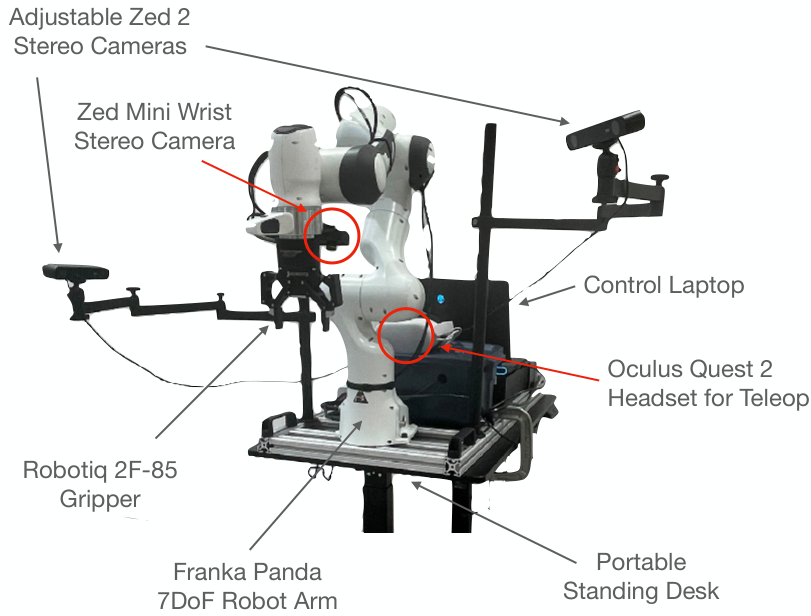
Pay for these roles in the United States clusters between $20 and $36 an hour. 1X advertises $28 to $36 an hour plus equity, RoboForce $30 to $35 on a contractor basis, Dyna $30 to $32, Figure's operator and pilot roles $26 to $32 ( 12 Figure roles are open now), and Collaborative Robotics $20 in Santa Clara and $22 in Seattle. In London, Humanoid's AI Data Collector role offers full training, no formal education requirement and a pension, though it does not publish a rate - Humanoid. Because most of these roles are teleoperation in practice, our teleoperation guide and the robot operator jobs board are the best next stops if this is your target.
3.2 Motion-capture and wearable demonstrator
A wearable demonstrator does not steer a robot. You do the task yourself while wearing the sensors, and the robot learns from your body. Tesla's Optimus program is the best-known example: its posting asks you to "wear motion capture equipment while performing designated movements" and to be between 5'7" and 6'3" tall, with shifts running day, evening and overnight - Tesla.
The gear is changing. Business Insider reported in August 2025 that Tesla told employees it would rely primarily on video recordings rather than motion-capture suits and teleoperation, using cameras attached to a helmet and a heavy backpack - Business Insider via Yahoo. Tesla's 2026 posting still lists motion capture equipment, so the suits were scaled back rather than dropped. Gloves are the other fast-growing format: Sunday Robotics says it has shipped "thousands of gloves" to its Memory Developers - Sunday, and its in-house Memory Developer role pays $35 an hour on a 2 pm to 10 pm shift in Redwood City - Sunday.
Handheld capture devices are the newest format. Generalist, which builds robot foundation models, says its GEN-1.5 model can learn a new task from a single demonstration of 3 to 12 seconds, and that such demonstrations can be "recorded either as human data (with a pair of handheld grippers) or as rollouts from the robot itself" - Generalist. The company's August 2026 video introduces the model and its one-shot learning from demonstrations.
Introducing GEN-1.5, a one-shot learner
For you, that means a growing share of demonstrator work involves holding or wearing a capture device rather than steering a robot. The trade-off is physical: wearable roles carry the heaviest body load in this guide, which we cover in section 9.
3.3 Paid recording sessions on site
Some collectors never touch a robot and never record at home. They report to a site, put on a head-mounted camera and work through a list of ordinary tasks during a scheduled session. TSMG, a contractor that describes itself as a "ground truth data collection partner" - TSMG, lists Video Recording Participant roles in many cities: you "wear a lightweight head-mounted camera while completing simple everyday or work-related tasks" and record at least 4 hours of video per scheduled project day - TSMG. You need a smartphone and must be of legal working age, and the posting says previous experience is not required.
These sessions are the easiest data collection work to get and among the lowest paid. Appen's project near Kuala Lumpur, for example, ran 9 am to 6 pm for four days at USD 3.60 an hour, with contributors responsible for their own transport to the site - Appen (no longer open). TSMG's postings publish no rate at all, so ask for the hourly figure, the payment schedule and whether travel time is paid before you accept a session. Sessions suit someone who wants occasional cash with no setup; they rarely lead anywhere on their own.
3.4 Recording at home
Home recording is the largest and most open kind of data collection work, and the one most people mean when they say they "get paid to train robots". You strap a phone or small camera to your head, do ordinary chores, and upload the footage. micro1's At-Home Video Recorder posting for the United States pays per hour of recorded video "that is in line with project guidelines", advertises $15 an hour of approved video, requires a recent iPhone, Pixel or Galaxy phone, and offers a $20 signing bonus after your first 20 hours - micro1. The same role for Latin America advertises $6 an hour - micro1. Perle pays "for every hour of accepted footage", prefers at least 10 hours of footage a week and requires you to be 18 or older - Perle.
Big consumer brands have joined. Figure's Index app sends you a recording device and pays you "by the minute while you do your tasks" - Figure Index, though its Google Play listing warns that "Demand is currently very high" and new sign-ups join a waitlist - Google Play. DoorDash pays couriers through its Tasks app for jobs like filming their hands washing at least five dishes while wearing a body camera, and says pay is shown upfront - TechCrunch. The app's App Store listing names 34 US states where Tasks is available, a list that leaves out California, New York, Texas and Washington - App Store. The photo below, from Figure's own page, shows the kind of head-mounted recorder involved.

Figure says it pretrained its Helix 2.5 model on Index footage, and that Index pretraining alone raised the robot's success in homes it had never seen from 9% to 56% - Figure. This official video shows the result across 30 such homes, which is the payoff the at-home recording industry is betting on.
Helix 2.5 30-Home Generalization
Rates vary even more at home than on site. In Los Angeles, the Los Angeles Times found Instawork handing out phone headbands for work that "pays $80 for two hours of footage" - Los Angeles Times via AOL. Sunday's remote Memory Developer role pays $30 per hour of approved data during a one-week screening and up to $60 for complex tasks afterwards, but excludes applicants in California, New York, Massachusetts, New Jersey and Illinois - Sunday. At the other end, the Atlas Capture app's own App Store screenshots advertise chores at $2 to $5 an hour - App Store.

One program is often misunderstood: Mercor's robotics capture program pays businesses, not individuals. It offers $12 to $18 per approved hour to restaurants, salons, workshops and similar businesses for wearable-camera video of their teams at work - Mercor. If you work at such a business, your employer would have to sign up. For a full walkthrough of filming technique, gear and the reasons footage gets rejected, read our egocentric capture guide.
3.5 Vehicle data collection driver
Self-driving and driver-assistance systems learn from enormous amounts of recorded driving, and someone has to drive the sensor cars. Sama's contract driver role in the Bay Area paid $25 an hour to "drive sensor-equipped vehicles along predefined routes", for about four hours a day during peak sunlight, and asked for a clean licence, a minimum age of 25 and proven trailer-reversing skills - Sama. TSMG's ADAS data collection drivers in Spain need a basic AV or ADAS certification, a clean driving record and B2-level English, and should be willing to travel for 1.5 to 2 years - TSMG.
The life can be demanding. TSMG's contract for a Japan driving project that ran from January to early June 2026 was an independent-contractor agreement, "not an employment contract", with about 6.5 to 7 hours of driving a day, roughly 30% of it at night, and sensor cleaning every one to two hours - TSMG. A lighter option is open to drivers in dozens of countries: micro1 pays $15 to $20 per hour of approved video for 360-degree footage of your own car on local roads, which it says drivers can fit into trips they already make - micro1. If you are drawn to vehicles, our autonomous vehicle operator jobs page lists the safety-driver and test-driver roles that often come next.
3.6 Drone and flight-test data collection
Autonomous aircraft need flight data the same way cars need driving data. Skydio's fixed-term Flight Test Operator role, posted in September 2026 and closed by early November, was the best-paid data collection job in this guide at $50 to $60 an hour, and its posting explained why: you "fly Skydio aircraft across a wide range of environments" and "collect, label, and manage high volumes of sensor, imagery, and telemetry data" - Skydio (no longer open). The bar was high, and a new posting is likely to keep it: an FAA Part 107 Remote Pilot Certificate, 100 or more hours of drone flying, a background check, the ability to lift 50 lbs, and a willingness to be on the road roughly 90% of the time.
That combination makes drone collection a specialist route rather than an entry point. If you already hold a Part 107 certificate, it is worth targeting directly; if you do not, the certificate is the gate, and the flying hours come from other drone work first. Our drone operator and UAV pilot jobs page tracks the flight roles that build that experience.
3.7 Shift lead and supervisor
Every data collection lab needs people to run it, and these are the best-paid on-site roles that do not require a pilot's licence. Nimble Robotics' Data Collection Supervisor pays $95,000 to $105,000 a year plus equity to lead a pod of roughly 8 to 12 operators and report "accepted episodes per operator-hour, rig uptime, attendance, and blockers" every day - Nimble Robotics. It asks for two or more years leading frontline hourly teams, which many retail, warehouse and restaurant managers already have.
The step below supervisor is often open to outsiders too. Collaborative Robotics' shift lead role in Seattle pays $24 to $25 an hour and asks for experience leading a shift in "retail, food service, or a similar fast-paced setting" - Collaborative Robotics. Tesla's Data Collection Operations Lead, Optimus role in Palo Alto lists $25.25 to $48.30 an hour. If you have run a team before, apply at this level instead of starting as an operator.
4. Who is hiring right now
Our feed tracks the job boards of robot labs, autonomous vehicle and drone companies, and data vendors every day. Today it holds 1,155 open roles, and 255 of them are demonstration collection or egocentric capture roles, the two kinds of work on the board that this guide is about ( 114 and 141). The chart groups those roles by employer.
Read that chart carefully, because postings are not people. One contractor, TSMG, accounts for 132 of those roles, since it publishes a separate listing for each city it recruits in, and Alignerr for 40. The rest come from many smaller employers, including 1X, Collaborative Robotics, Dyna Robotics, Dexmate, Genesis AI, Humanoid, Nimble, RoboForce, Sama, Skydio and Perle. Home recording looks small only because most of it runs through apps such as Figure's Index and DoorDash Tasks rather than job postings, so it never appears as a listing at all.
Location tells a similar story. The United States has the most, with 134 roles open to applicants there, but the roles are spread across many countries, posted city by city in Europe, Japan and Southeast Asia. A role open in several countries counts in each country below.
Here are representative live postings from the feed, with the pay each one advertises, quoted from the postings as checked on October 28, 2026. The last column counts each employer's open demonstration collection and egocentric capture roles today, and the live board shows all of them.
| Employer | Job title | Where | Advertised pay | Terms | Open now |
|---|---|---|---|---|---|
| Skydio | Flight Test Operator, Data Collection | San Mateo, CA, ~90% travel | $50-$60/hr | 12-month fixed term | 0 |
| Nimble Robotics | Data Collection Supervisor | San Francisco | $95k-$105k/yr + equity | Salaried | 1 |
| RoboForce | Data Collection Operator (swing shift) | Milpitas, CA | $30-$35/hr | Contractor | 1 |
| 1X | Operator, Data Collection (swing shift) | San Carlos, CA | $28-$36/hr + equity | Full time | 1 |
| Dyna Robotics | Data Collection Operator | Redwood City, CA | $30-$32/hr | Contract | 0 |
| Tesla | Data Collection Operator, Optimus | Palo Alto and Fremont, CA | $25.25-$34.50/hr | Employee, with stock awards and benefits | 16 |
| Sama | Driver, Data Collection | Bay Area | $25/hr | 4-month contract | 1 |
| Collaborative Robotics | Robotics Data Collection Operator | Santa Clara / Seattle | $20-$22/hr | Full time through March | 5 |
| micro1 | At-Home Video Recorder | Remote, 40 US states | $15 per accepted hour of footage | Contractor | 13 |
| Appen | EGO Embodied Data Collector | Kuala Lumpur area | USD 3.60/hr | Project contractor, 4-day project | 0 |
Outside the job boards, the largest employers of data collectors are not in this table at all. China had announced more than 40 state-owned robot data collection centers by December 2025, with about two dozen operating, according to Interact Analysis - Rest of World. JD.com plans to generate 10 million hours of robotics training data over two years and eventually bring 500,000 external workers into data collection - Rest of World. In India, AFP described a growing army of thousands of AI system trainers, among them a woman in Chennai earning just over $2 for an hour of video filmed in her kitchen - AFP via RNZ.
Why this matters: the openings you can see are concentrated in a few US hubs and a few big contractors, while the volume of the work is increasingly global and app-based. How to apply it: if you live near a lab hub (the Bay Area, Seattle, London, Paris), the on-site postings are your best-paid route; everywhere else, look at home-recording programs that accept your country, and set a job alert on our board for the kinds of work you want, so new listings reach you by email.
5. What data collection jobs pay
Pay in this field is easier to compare once you separate three units that postings mix freely: dollars per hour worked, dollars per accepted hour of footage, and dollars per task or minute. Employment jobs on site almost always use the first. Home recording almost always uses the second or third. The chart below covers the first: the hourly ranges advertised by on-site data collection jobs in the United States that publish a figure.
The pattern is clear: most on-site robot data collection in the United States pays $25 to $36 an hour, with licensed drone work well above that band and entry-level teleoperation at Collaborative Robotics ($20 to $22) below it. Figure's operator and pilot roles pay $26 to $32 depending on the role, and Tesla adds cash and stock awards and benefits on top of its $25.25 to $34.50 range for operators. Tesla's Data Collection Operations Lead postings go higher: in 2024, Fortune reported Tesla's range as $25.25 to $48 an hour - Fortune, and the lead postings now state $25.25 to $48.30 ( 2 open roles state a top rate of $48 or more), while the operator postings top out at $34.50. For the board's own measure of the same work, the demonstration collection roles that state a rate typically pay $25 to $45 an hour, with a median of $30.
Remote and per-footage pay is harder to read because each program uses its own unit. The table lists what the programs and reporters actually state.
| Program or source | What you are paid for | Stated rate | Where |
|---|---|---|---|
| Sunday Robotics (Memory Developer, remote) | Hour of approved data | $30, up to $60 after screening | US, excluding 5 states |
| Instawork (reported) | Footage delivered | $80 for two hours | Los Angeles |
| micro1 (At-Home Video Recorder) | Hour of recorded video meeting guidelines | $15 | 40 US states |
| micro1 (LATAM) | Hour of recorded video | $6 | 12 Latin American and Caribbean countries |
| Mercor robotics | Approved hour, paid to a business | $12-$18 | Businesses only |
| Figure Index | Minute of recording | Not published | App downloads in 108 countries |
| DoorDash Tasks | Each task | Shown upfront per task | 34 listed US states |
| Home recorders in India (AFP) | Hour of video | Just over $2 | India |
| Home recorders in China (Rest of World) | Hour of chores filmed | 20 yuan (about $3) | China |
The hidden cost in every per-footage rate is the time that never gets paid. Suppose you record 12 hours in a week at $15 per accepted hour and the reviewer accepts 9. You earn $135, which is $11.25 per hour of recording, and less again once you count setting up, re-shooting, charging, uploading and waiting for review. Reporters keep finding the same gap: the Los Angeles Times described a couple whose cooking video was disqualified because steam blocked the camera - Los Angeles Times via AOL, and Australia's ABC found collectors earning between US$3 and US$10 an hour, with some platforms charging a fee of about US$1 to withdraw balances under US$10 - ABC News.
Employment type changes the math as much as the rate does. A US contractor paid on a 1099 covers both halves of Social Security and Medicare, while an employee's employer pays half, and employees often get benefits that contractors do not: 1X offers a 401(k) match and equity, Humanoid in London an employer pension contribution. So a $30 contract hour can be worth less than a $28 employee hour once taxes and benefits are counted (section 10 has the details). How to apply all this: convert every offer into what you would earn per hour of your actual time, after rejections, unpaid prep and taxes, before you compare it with anything else. For live pay across all robot-training work, our pay explorer and the highest-paying platforms ranking update from the same feed every day.
6. What employers ask for
Most data collection jobs need no degree and no robotics experience, but they are far from requirement-free. The requirements fall into four groups: your body, your skills, your equipment and your availability. The physical ones surprise people most, because they are written for equipment rather than for the job title.
Height windows are the clearest example. Tesla asks for 5'7" to 6'3" because the role uses motion-capture equipment - Tesla, and 1X asks for 5'5" to 6'0" "to safely operate required VR equipment" - 1X. From first principles this makes sense: a demonstration teaches a robot how a body of roughly its own proportions moves, and the suits and rigs are built for a range of body sizes. If you fall outside a window, the right move is to target teleoperation stations, gloves, home recording or driving, where no height range applies.
| Kind of job | Typical physical demands | Other requirements |
|---|---|---|
| On-site robot data operator | Lift up to 50 lbs, wear 30 lbs of gear (1X); up to 7 hours on your feet with breaks ( RoboForce) | VR comfort; some ask for an associate or bachelor's degree "or equivalent" (Dyna, RoboForce) |
| Wearable demonstrator | Walk 7+ hours carrying up to 30 lbs ( Tesla) | Height window; day, evening or overnight shifts |
| Recording at home | A head strap for hours at a time | A recent phone ( micro1 and Perle list iPhone, Pixel and Galaxy models); a clean, well-lit space; 18+ |
| Vehicle data driver | 4 to 7 hours of driving a day | Clean licence; 25+ ( Sama); certification and B2 English ( TSMG ADAS) |
| Drone data collection | Lift 50 lbs; outdoors in heat, cold, wind and rain | FAA Part 107 and 100+ flight hours; background check ( Skydio) |
The table hides an important pattern: the jobs with the fewest formal requirements (recording at home and on-site sessions) have the lowest and least predictable pay, while every step up in pay adds a requirement such as a location, a body measurement, a licence or a schedule. Skills matter at the margins. Adexis says no robotics or tech background is needed but values experience with "gaming, VR, musical instruments, crafts, barista work, or anything that proves repetitive, fine motor skill" - Adexis. Senior roles add technical skills: Genesis AI's senior operator should be comfortable with Linux, Python scripting and hardware troubleshooting - Genesis AI.
How to apply this: read each posting's requirements line by line before you apply, and treat physical limits as hard filters rather than preferences. Then put your evidence of steadiness and fine motor control in the first lines of your application, because that is exactly what these employers are screening for.
7. How to get hired
Getting hired for data collection work is less about credentials than about proving you will show up, follow instructions exactly and repeat a task cleanly for hours. Employers lose money on operators who quit after a week or produce footage that fails review, so the hiring process is designed to filter for reliability. The good news is that this rewards the kind of record many people already have from retail, hospitality, warehouse, gaming or craft work.
The process is also fast compared with most jobs. Many labs hire on rolling campaigns, contractors fill projects within days, and home-recording programs approve applicants in batches. That speed cuts both ways: a strong application can have you working quickly, while a vague one is easy to pass over. Five habits separate the two, and they work across all seven kinds of job.
Search by every title, on the employer's own board. Search for each of the titles in section 1, not just "data collection", and open each posting on the employer's own job board (most use Ashby, Greenhouse or Lever) rather than a copy on a reposting site. You see the full market instead of the slice that uses one keyword, and the original posting protects you from fake copies (section 11).
Lead with reliability. Put attendance records, shift work, repetitive precision and any VR or gaming experience in the first three lines of your application. A hiring manager reading fifty applications is looking for evidence you will last; the Nimble supervisor posting shows the job is measured in accepted episodes per operator-hour and attendance.
Prepare for a trial task. Some employers test you on the work itself: Adexis's hiring process includes a 30-minute in-person session where you try a sample task - Adexis. Arrive rested, listen to the full brief before you start, and repeat the movement the same way every time rather than faster.
Treat the first weeks as probation. Sunday pays during a one-week screening period before offering its higher rates - Sunday. New micro1 recorders must complete an ID check within 48 hours of being contacted - micro1. The trial and the first weeks are where most applicants are actually decided, so follow the task brief exactly, ask questions early and keep your takes clean.
Ask about conversion. Contract roles can turn into permanent ones: Dyna Robotics says outstanding contract performers may be considered for a full-time position - Dyna Robotics (no longer open). Ask at the offer stage how often that happens and what the criteria are, because a contract that converts is worth far more than its hourly rate suggests.
If you have more than one option, apply to several kinds of work at once. A home-recording program can bring in money within days while an on-site application works its way through a lab's process, and a contractor project can give you a verifiable line for your next application. On our live board you can sign up for a job alert that emails you new openings in the kinds of work you select, which matters because rolling campaigns often fill quickly.
8. What the work is really like
The honest description of data collection work is repetition. Business Insider's reporting on Tesla's Optimus lab described collectors repeating each action hundreds of times during eight-hour shifts, often wearing a 30- to 40-pound backpack, and expected to gather at least four hours of usable video per shift - Business Insider via AOL. At a robot data training center in Beijing, an instructor told CNBC that a typical day is 8 hours of repetitive motions - CNBC. One trainer in China told Rest of World, "We call ourselves cyber-laborers" - Rest of World.
Skill shows up in the success rate rather than the speed. Reuters reported that at one Chinese center, a novice trainer might produce one usable robot movement in 300 attempts, while an experienced trainer gets one in 50 - Reuters via Insurance Journal. Sunday's Memory Developers perform demonstrations "at about half of natural human speed" - Sunday. Everything you produce then passes through review, which decides what you are paid for, as the diagram shows.
Pay is usually tied to the review step, not the recording step
Review is where most frustration comes from. MIT Technology Review found that micro1's videos are "reviewed by both AI and a human and are either accepted or rejected" - MIT Technology Review, and Figure describes a pipeline of "filtering, fraud review, deduplication, rebalancing, and annotation" for Index footage - Figure. Rules are specific: micro1's 360-degree recording role, read in October 2026, required each continuous clip to be at least 60 seconds long - micro1. App-store reviews of Atlas Capture include complaints that videos are rejected without a response to appeals - App Store. Read the guidelines twice, film a short test, and keep your hands in frame and the light even.
On-site jobs add schedules and performance reviews. Shifts run from early morning to midnight: RoboForce's swing shift is 3 pm to 11 pm - RoboForce, Humanoid rotates between 6:30 am to 2:30 pm and 2:30 pm to 10:30 pm, and Tesla runs an overnight shift. Business Insider reported that Tesla cut dozens of data collectors in September 2025 after twice-yearly performance reviews, so output and quality are tracked. Why this matters: the job is sustainable for people who find rhythm in repetition and miserable for people who need variety. How to apply it: before you commit, ask what the daily output target is, how quality is measured, and what happens to someone who misses it.
9. Your body: VR sickness, strain and safe habits
Job postings describe the physical demands of data collection in a line or two. The reporting describes them more fully. Business Insider spoke to Tesla Optimus collectors who said they saw colleagues sustain back and neck injuries, one former worker said they hurt their back training the robot, and three people said poor image quality combined with long hours in the gear triggered severe motion sickness - Business Insider via AOL. Those are interviews rather than injury statistics, and we found no published injury data for this work, but they match what the research on headsets and repetitive work would predict.
VR sickness is the risk most specific to operators who teleoperate through a headset. A 2023 review of VR at work found that at least one-third of users experience cybersickness, 5% of them severely, and that its occurrence rises in step with exposure time - Frontiers in Psychology. An earlier meta-analysis of 46 experiments found that 15.6% of participants dropped out because of VR sickness - Frontiers in Human Neuroscience. The same 2023 review notes that headset weight adds stress on the cheekbones and the back of the head, and that wearing a helmet during screen use induces neck pain. Repetition is the other risk: the US National Institute for Occupational Safety and Health lists awkward postures and higher intensity, frequency and duration of activity among the work conditions that cause or worsen musculoskeletal disorders - CDC/NIOSH.
The habits that protect you are simple, and the time to raise them is before you accept the job:
| Habit | What to do |
|---|---|
| Ask about breaks | General guidance for VR at work limits immersion to 20 to 30 minutes at a time, with regular breaks |
| Report symptoms early | Cybersickness builds with time in the headset, so mention dizziness, nausea or eye strain as soon as it starts |
| Fit the gear properly | Carry backpack weight on your hips and adjust straps before the shift starts |
| Vary the motion | Alternate hands and tasks where the task brief allows it, and stretch between takes |
| Cap head-strap sessions at home | You set the schedule, so split long recording days into blocks |
None of this is about being fragile. Well-run programs build breaks into shifts (RoboForce's posting specifies scheduled breaks) because a sick or injured operator produces no usable data, and the review guidance above comes from people studying VR as a workplace tool, not as a game. Why this matters: cybersickness rises with exposure time, and this job is built on exposure time. How to apply it: ask in the interview how long a typical session in the headset lasts, how often breaks happen and what the policy is when someone feels unwell, and treat a vague answer as information about the employer.
10. Contracts, taxes and the privacy of your home
Two questions decide how much of an offer you actually keep and how much of your life you hand over: what kind of contract you are on, and what happens to the footage. Both are easy to skip when a posting looks attractive, and both are much harder to fix after you start.
10.1 Employee, contractor or gig worker
The same work comes under three arrangements. Some collectors are employees: 1X's operator role is full time with a 401(k) match and equity, and Humanoid's London role includes 23 days of annual leave and a pension with an 8% total contribution. Others are contractors: Dyna Robotics and RoboForce hire on contract, Dexmate's role is a 1099 contract, and TSMG's Japan drivers sign an agreement that states it is "not an employment contract". Home recorders are almost always paid per output as independent contractors, as Perle's Malaysia and Indonesia posting labels its role.
In the United States the difference shows up in tax. The self-employment tax rate is 15.3%, made up of 12.4% for Social Security and 2.9% for Medicare - IRS. An employee pays half of those taxes, 6.2% and 1.45%, and the employer pays the other half - IRS. On a $30 contract hour the full 15.3% comes to about $4.59 before the deduction contractors can claim, while on a $28 employee hour the worker's share is about $2.14. The two hours leave similar money before income tax, and the employee hour usually comes out ahead once health benefits, retirement matching and paid leave are counted.
The label on your contract is not always the final word. The US Department of Labor warns that misclassified employees "may not receive the minimum wage and overtime pay to which they are entitled" - US Department of Labor. The rules are also in flux: in February 2026 the department proposed returning to its 2021 test for who counts as an independent contractor - Federal Register, and no final rule had been published when we wrote this. How to apply it: ask "W-2 or 1099?" before you accept, set money aside for tax if you are a contractor, and keep your own record of hours, accepted output and payments.
10.2 Recording inside your home
Home recording turns your home into part of a dataset. MIT Technology Review put it plainly: the videos capture "the interiors of their homes, their possessions, their routines" - MIT Technology Review. Program terms vary, and some allow your footage to travel further than you might expect. Figure's Index privacy policy covers recordings "of you and/or of your environment" and lists "Commercial Purchasers" to whom it may sell or disclose personal data, while offering an opt-out of sale - Figure. Experts quoted by Australia's ABC raised concerns about data from home filming being sold on to third companies - ABC News.
Most programs set rules about who and what may appear on camera, and you are responsible for following them. DoorDash's Tasks rules, as WIRED described them, include not recording minors, personal data or anything illegal, asking for consent before filming anyone else, and avoiding locations such as hospitals, schools and airports - WIRED. In India, MediaNama reported that the privacy policy of Pronto, a home-services app running an in-home recording pilot, "makes no mention of children's data", although the pilot operates in homes where children live - MediaNama. The law can apply too: Illinois' biometric privacy law covers scans of "hand or face geometry" and requires written consent, with statutory damages of $1,000 to $5,000 per violation - Davis Wright Tremaine.
Before you record at home, settle five things:
| Check | What to look for |
|---|---|
| Who can buy the footage | Whether the terms allow sale to third parties, and whether you can opt out |
| Who else appears | Consent from every adult on camera, and no children at all |
| What is in frame | Faces, screens, mail, documents and anything showing your address |
| How long it is kept | A stated retention period and a way to request deletion |
| What happens after payment | What the program does if footage breaks its rules after it has paid you |
Those questions are not paranoia; they are the same ones the platforms' own rules raise. When a program will not answer them in its terms or its help pages, assume the broadest use of your footage and decide whether the pay is worth it on that basis. Why this matters: once a recording is sold or shared, you cannot take it back. How to apply it: record in one or two rooms you have cleared for filming, keep a short checklist of what must stay out of frame, and keep copies of the terms you agreed to.
11. Scams and red flags
Any work that can be done from a phone, pays per task and is hard for outsiders to understand attracts scammers, and AI training work is all three. The US Federal Trade Commission reports that complaints about job scams and fake employment agencies nearly tripled between 2020 and 2024, while losses grew from $90 million to $501 million - FTC. One fast-growing variety is the "task scam", which dresses up as simple online work: losses in the first half of 2024 alone topped $220 million, from about 20,000 reports, compared with about 5,000 reports in all of 2023 - FTC.
AI training brands are already common disguises. DataAnnotation, a platform for text-based AI training work, warns that "some individuals have used our name and brand to commit fraud" and that it will never ask workers for money - DataAnnotation. Business Insider found at least 100 Facebook groups selling access to real and fake AI training accounts - Business Insider. We have not yet seen reputable reports of scams posing specifically as robot data collection programs, but the pattern transfers directly: the same scripts work for "film chores for a robot company" as for "rate chatbot answers".
The red flags are consistent. The FTC's April 2026 alert puts the first two plainly: real employers will never contact you about a job through unexpected texts, WhatsApp or Telegram messages, and you should never pay to get paid or to get a job - FTC.
| Red flag | What it looks like |
|---|---|
| An unexpected message | A job offer by text, WhatsApp or Telegram from someone you never contacted |
| Paying to get paid | Fees for starter kits, training, certifications or "account activation" |
| A check to deposit | A request to deposit a check and send part of it back, which is a fake check scam |
| An account for sale | Someone offering to sell or rent you access to a data platform account |
| No named employer | A recruiter who will not name the company, or pay far above every real posting in this guide |
The test that separates real programs from fake ones is the direction of the money. Legitimate data collection work pays you or reimburses you: micro1 adds a $20 signing bonus and headstrap reimbursement after 20 hours, Perle gives a budget for the headstrap, and Figure sends Index creators a recording device. A scam asks you to pay first, in some form, and the FTC's guidance on job scams warns about exactly the "starter kits, so-called training, or certifications" that never lead to work - FTC. How to apply it: find every offer on the employer's own careers page or job board before you share documents, never pay to start, and report scams to the FTC or your country's equivalent. Every listing on our board links to the employer's own posting or official program page.
12. Where data collection jobs lead
Data collection is an entry point, and the people who do it well have somewhere to go. The clearest ladder runs inside the operation itself: operator, then shift lead, then supervisor, then data operations management. The pay steps are real. Collaborative Robotics pays its Seattle shift leads $24 to $25 an hour against $22 for operators, and Nimble's supervisor role pays $95,000 to $105,000 a year plus equity. Senior operators at labs like Genesis AI design the task setup, props, environment and standard operating procedures for collection, which is a step toward running collection programs.
The second ladder runs toward judging robots rather than teaching them. Collectors learn what good and bad robot behavior looks like faster than almost anyone, which is the core skill of robot quality assurance and evaluation, covered in our robot QA and evaluation guide. Others move toward keeping deployed robots running, the work described in our fleet operations guide. Companies move people across these teams too: Tesla reportedly moved much of its self-driving data annotation team to Optimus - Electrek.
The third ladder is a licence. Drone flight-test work pays the most in this guide because the Part 107 certificate and flight hours are scarce, and vehicle data collection can lead into safety-driver and test-driver work. How to apply this: from your first month, keep a simple record of your accepted output, any quality scores, the rigs and tools you used and any times you trained someone. That record is what turns "data collector" on a CV into a promotion or a better-paid job at another lab.
13. Will these jobs last?
The fair question about any job built on a shortage is what happens when the shortage ends. There are three serious threats to human data collection, and each is real. The first is simulation: Nvidia says its researchers used synthetic training data to develop its GR00T N1.5 robot model in 36 hours, against what would have taken nearly three months of manual human data collection - Nvidia. The second is ordinary human video: the EgoScale project trained on more than 20,854 hours of action-labeled first-person video and reported a 54% improvement in average success rate - EgoScale. The third is the robots themselves, which increasingly learn from their own attempts, or "rollouts from the robot itself" in Generalist's words - Generalist.
The counter-evidence is also strong. A CVPR 2026 study estimated that about 8 simulation samples give the benefit of 1 teleoperated sample - CVPR 2026 Findings. The robotics researcher Sergey Levine argues that "real data is indispensable if we are to truly build robotic foundation models" - Sergey Levine. Even the human-video results usually end with a step that needs real robot data: the HumanScale study recommends adapting "with a small amount of labeled real-robot data" - HumanScale. And the substitute for robot data is still human data: Generalist says its GEN-1 base model was trained "without any robot data", using data "from low-cost wearable devices on humans doing millions of activities" - Generalist.
Reasoning from first principles, the question is not whether people will be paid to produce physical data, but which people and at what rate. Every substitute so far moves the work from expensive setups (a robot, a lab, an operator) toward cheaper ones (a person wearing a camera at home). That shift points to more data collection jobs, not fewer, but with a split in pay. The commodity tier of home recording can be done from any country, so its rates converge toward what people accept in lower-cost places, which is why the same micro1 role pays $15 in the United States and $6 in Latin America. The premium tier is work that cannot be shipped abroad or done by anyone: skilled teleoperation in a lab, licensed driving and flying, supervision, and expert trades. micro1's own video about an electrician helping train AI points the same way - micro1.
The scale of planned spending supports that reading. Figure says it has committed to spend over $1 billion in the next 12 months on data and compute - Figure, and Morgan Stanley projects a humanoid robot market of $5 trillion by 2050 - Morgan Stanley. The risk is to individual programs rather than the field: a Reuters visit to one Chinese training center found staff saying it currently had no clear path to profitability - Reuters via Insurance Journal, and Tesla's cuts show that collectors are exposed to strategy changes. AI agents are also changing the work around collection, from AI reviewers that accept or reject footage to automated job feeds like ours. How to apply it: treat home recording as income, not a career; if you want a lasting place in the field, aim for the skilled tier (teleoperation, supervision, evaluation or a licence) within your first year.
14. How we researched this guide
The open-role counts, employer names and advertised pay in this guide come from the RobotTraining.jobs feed, which re-reads each tracked employer's own job board every morning and records what each posting states. The counts and pay bands written as links in this guide are read from that feed each time the page loads, and each opens the list it counts. Postings quoted in the text and tables are quoted only as the employer advertises them, never as an estimate, and were rechecked on October 28, 2026. Where a posting conflicts with itself or with older reporting, we say so in the text. Every other figure links to the posting, paper or report it came from, checked on October 5, 2026 unless the text names a later date, and our methodology page explains how the feed handles missing and unusual pay.
There is one more fact about how this guide is produced. RobotTraining.jobs is built and operated on Founden, a platform that our founder, Yuma Heymans, also runs, and an AI agent on it writes and maintains the code behind the daily feed. AI-run operations have blind spots, as Founden's own measured results from an AI improvement loop show: across 116 runs on six companies, the loop chose, made and deployed its own changes, yet none of those runs read analytics data or started any outbound activity, such as emails or social posts. That is why every number in this guide points to a source you can check yourself.
Two disclosures matter for how you read the rest. RobotTraining.jobs earns a referral fee when someone applies to micro1 through this site's apply links, which never changes what micro1 pays you; our referral disclosure lists how that works. We also hold a Mercor referral account, but the business program covered here carries no referral link. We have no relationship with any other employer in this guide, and the scores in the table at the top use the same criteria and the same kind of evidence for every kind of job.
15. Frequently asked questions
What is a data collection job in AI and robotics?
It is paid work that produces training data for robots and AI systems. You perform physical tasks, either yourself while wearing cameras or sensors, or by piloting a robot, and the recordings teach robot models how to do those tasks. It is different from traditional data collection jobs such as survey interviewing or field research.
How much do data collection jobs pay?
On-site robot data collection jobs in the United States mostly advertise $25 to $36 an hour, licensed drone flight-test work pays $50 to $60 an hour, and supervisors earn around $95,000 to $105,000 a year. Home recording pays per accepted hour of footage or per task, from about $2 to $3 an hour in India and China to $15 per hour of approved footage in the United States, with some specialist programs paying more. On this site's board, the demonstration collection roles that state a rate typically run $25 to $45 an hour (median $30), and egocentric capture roles $7 to $30.
Do I need experience or a degree?
Most data collection jobs need neither. Several labs say no technical background is required and provide full training. Some on-site roles ask for an associate or bachelor's degree or equivalent experience, and drone and driving roles require a licence and a clean record.
Can I do data collection jobs from home?
Yes. Programs such as micro1, Perle, Figure's Index app, DoorDash Tasks, Atlas Capture and Sunday Robotics pay people to record everyday tasks at home with a phone or head-mounted camera. Each program limits which countries or states it accepts, and most pay only for footage that passes review.
What does a Tesla data collection operator do?
Tesla's Optimus data collection operators wear motion-capture equipment and camera rigs while performing movements that train the Optimus humanoid robot. Tesla's 2026 posting asks applicants to walk more than 7 hours a day carrying up to 30 lbs, to be between 5'7" and 6'3" tall, and lists pay of $25.25 to $34.50 an hour plus cash and stock awards and benefits.
Why do some data collection jobs have height requirements?
The motion-capture suits and VR rigs are built for a range of body sizes, and the demonstrations work best when the collector's body is close to the robot's proportions. Tesla asks for 5'7" to 6'3" and 1X for 5'5" to 6'0". If you fall outside a window, teleoperation stations, gloves, home recording and driving roles usually have no height limit.
What does "per accepted hour of footage" mean?
It means you are paid only for recorded time that passes the buyer's quality review. Time spent setting up, re-recording, uploading and footage that gets rejected is unpaid, so your real hourly rate is lower than the advertised one.
Are data collection jobs legit?
Many are, and the safest are posted on the employer's own job board or offered through a named, established platform. Be cautious of any offer that asks you to pay for training or equipment upfront, recruits you through a messaging app, or promises high pay for very little work.
Will robots replace data collection jobs?
Simulation and ordinary human video are reducing the need for some expensive lab data, but research so far finds that real-world data remains necessary, and the cheapest substitute is still people wearing cameras. The likely change is a shift in which jobs exist and what they pay rather than an end to the work.
This guide reflects programs and reporting as of October 5, 2026, with open-role counts and pay bands read from the live board and the postings it quotes rechecked on October 28, 2026. Pay, requirements and openings change often, so check the live posting before you apply.