Robot training work
Robot Test Operator and QA Jobs
Evaluation & QA roles open now
Updated 1 Nov 2026, 06:02 UTCSome links here are referral links: when you join an employer through one, RobotTraining.jobs may receive a commission. It costs you nothing, and the employer pays you exactly the same.

Robot Test Operator (opens the job details)
Pickle Robot · Charlestown, MA, United States· 1mo agoDetails
$30/hr

 $190,000–$234,000/yr
 $30–$35/hr
- GBP 97,000-105,000/yr
- $130,000–$160,000/yr
Run trained policies on real robots and score success or failure, review collected demos for acceptance, and red-team embodied systems for unsafe behavior. Often folded into senior-operator and data-ops titles, and the tier where domain judgment (a trade skill, a clinical or industrial background) starts to command a real premium over volume work.
How contested these jobs are
From 4 Oct 2026 to 31 Oct 2026, Robot Task Evaluation & QA roles drew 0% of the apply clicks on RobotTraining.jobs while making up 1% of the time roles were open, so each opening drew 0.00x the attention of an average role. Fewer people chase each opening than in most kinds of work, so a fitting application stands out more easily.
Measured from apply clicks on this site, not from hires. Every kind of work compared.
Evaluation & QA alerts
Get new Evaluation & QA roles by email
Each week we gather the latest paid Evaluation & QA openings from every employer we follow, with the hourly rate where it is posted, and send them in one email. No cost, and you can stop any time.
Only job openings, nothing else. Unsubscribing takes one click.
What evaluation & QA jobs pay, by job title
In short
Robot Task Evaluation & QA. Run trained policies on real robots and score success or failure, review collected demos for acceptance, and red-team embodied systems for unsafe behavior. Not enough open roles post a rate for a live figure. Compiled from employers' published hourly rates, it comes to $30–$33/hr. Hiring for it: 21 employers, among them TELUS Digital AI Community, RoboForce, Anduril Industries.
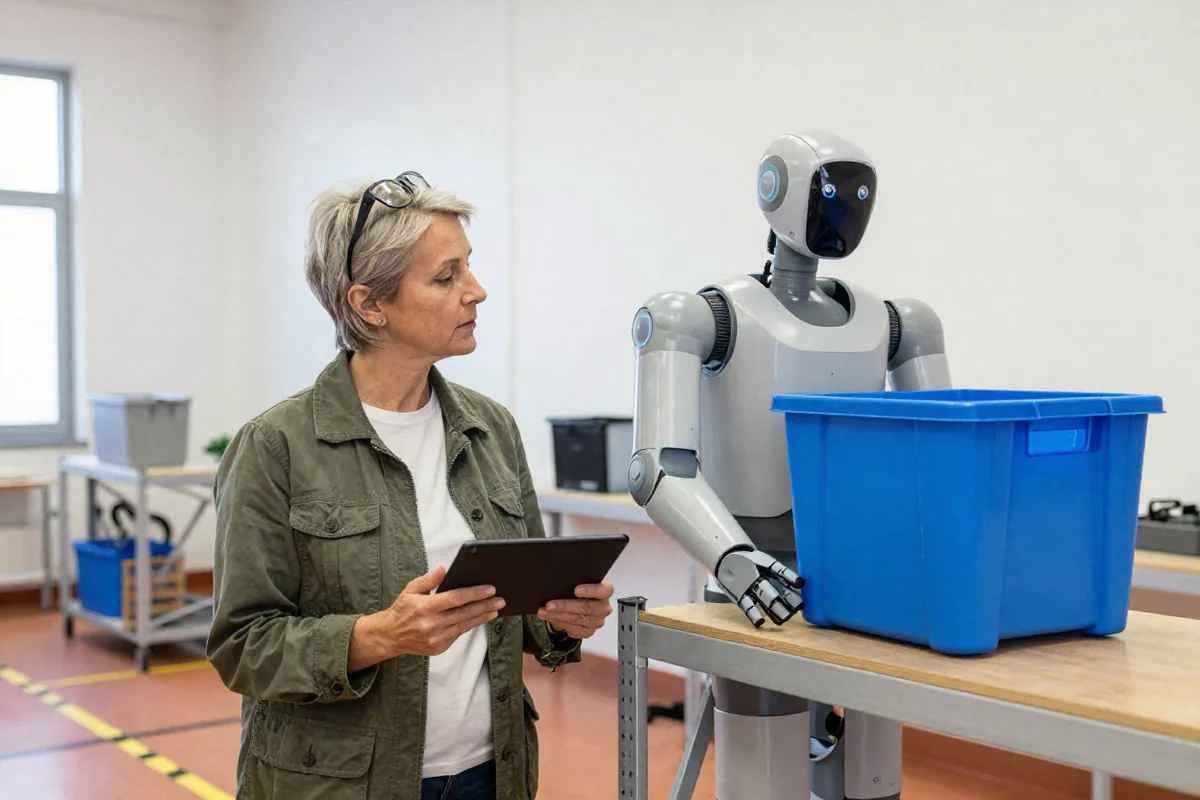
The job, up close
Test robot tasks
Watch a robot attempt a task, score the result, and document mistakes. Some roles also review recorded demonstrations.
- A sample task
- Watch a robot set a tote down in the right place, score the attempt, and log what went wrong.
- Workplace
- A test lab, with some video-review work done remotely
- Tools and kit
- A robot test setup, task checklist, and reporting software
Employers hiring for evaluation & QA


















Sorted by what an application there is likely worth to you, with a referral lift for employers that pay us a referral fee; your pay is never affected.
Want more context? Line up evaluation & QA pay at every employer in the pay explorer.
A technician or a tester?
Fill in a single profile and any robot training employer can reach you through us. When a company needs someone in a certain city or country, or holding a license or certificate, and you fit, we put you forward, but only after you say yes. It costs nothing.
Written by Yuma Heymans, Founder & CEO of RobotTraining.jobs.
Runs RobotTraining.jobs and AITraining.jobs as founder and CEO, and co-founded HeroHunt.ai, an AI recruitment platform. San Francisco based, and for years focused on how the people who teach robots and AI systems are found, hired and paid.
Robot task evaluation and QA is the job of judging whether a robot actually did what it was asked to do. After a humanoid or mobile robot runs a trained policy (the neural network that decides how it moves), a person watches the attempt, decides whether it succeeded or failed, scores how far it got, and writes down exactly what went wrong. It is the closing loop of embodied AI. Labs like Figure, 1X, Tesla, and Boston Dynamics cannot ship a robot that folds laundry, moves boxes, or walks a warehouse until a human has run its policy hundreds of times on real hardware and graded every single run.
At RobotTraining.jobs we track this work because it is one of the more accessible on-ramps into robotics: the operator tier often needs no degree, just patience, consistency, and a careful eye. This guide covers what the work is day to day, what it honestly pays as a worker wage (not the inflated "data cost" figures labs quote investors), who is hiring, and how to get started.
What Robot Task Evaluation & QA Actually Is
The core loop is the same across almost every lab. You set up a physical scene (say, a table with a mug, a towel, and a bin), you trigger the robot to run its trained policy, and then you grade the attempt against a rubric. The most common score is the success rate: did the robot complete the task within a fixed number of tries? But a single pass/fail is too coarse for engineers to learn from, so evaluators also assign a progress score: the task is split into stages (grasp the mug, lift it, place it, release), and you award points for each stage the robot reaches before it fails. When it fails, you tag the failure mode: wrong object, slipped grasp, collision, froze, or ignored the instruction.
The day-to-day work spans four related jobs:
- Live policy evaluation. Run the current model on real hardware, dozens or hundreds of trials per task, and log success, progress, and failure reason for each.
- Demo acceptance review. Before teleoperated demonstrations are used to train the next model, a QA reviewer watches them and rejects the ones that are jerky, off-task, unsafe, or low quality. Bad demos poison the training set.
- Regression and QA testing. Confirm that a new model version did not get worse at tasks it used to pass, the same idea as software QA but on a physical robot.
- Red-teaming. Deliberately push an embodied system toward unsafe or unexpected behavior (cluttered scenes, ambiguous instructions, adversarial objects) and document where it breaks.
Bias is the enemy of good evaluation. Serious programs use a fixed "controlled tester" protocol so that the person resetting the scene does not accidentally help the robot, and NVIDIA's RoboLab exists specifically because ad-hoc evaluation "lags behind gains in robotics foundation models." This is real, structured measurement work, not watching a robot for fun.
Note that evaluation and QA is adjacent to, but distinct from, teleoperation and data collection: collectors generate the demonstrations, evaluators grade what the trained model does with them. Many operators do both across a shift.
What Robot Evaluation & QA Pays
Read from today's open roles. 9 open roles on RobotTraining.jobs are in robot evaluation and QA, and 2 of them state an hourly rate. The board publishes a typical band for a kind of work only when enough employers state a rate; the pay explorer shows whether this kind has one yet. They come from individual postings with different duties and locations, not from a category-wide wage survey; the pay explorer and pay report show the full measured sample and its coverage.
| Employer | Open roles | Of those, stating an hourly rate |
|---|---|---|
| All employers | 9 | 2 |
| Waymo | 3 | 0 |
| Waabi | 2 | 0 |
| Pickle Robot | 1 | 1 |
| RoboForce | 1 | 1 |
| Avride | 1 | 0 |
An advertised hourly amount is gross compensation, not verified take-home earnings. Salary, equity, benefits, overtime and contractor expenses must be compared separately. We do not infer what a beginner or an expert earns by splitting a pay distribution into tiers.
For accepted-footage or task payments, include setup, recording, upload, review and any rework in your time calculation. An hour of accepted video is a unit of output, not necessarily an hour of labor. There is no guaranteed volume of accepted tasks or paid hours.
Who Is Hiring and What They Look For
The hiring pipeline for robot evaluation and QA runs through two channels. The first is the humanoid and robotics labs directly: Figure, 1X, Tesla (Optimus), Boston Dynamics (Atlas), Apptronik, Skild AI, Agility Robotics, and Sanctuary AI all post operator, technician, and QA roles on their own careers pages. The second is autonomous-vehicle and services companies ( Nuro, Waymo, Zoox, Aurora, Serve Robotics) that need people to review and score autonomous runs.
For the operator and QA tier, hiring managers want reliability over resume. The traits that get you hired and kept: consistency (you grade the hundredth trial as carefully as the first), attention to detail, comfort following a strict rubric, physical presence and dexterity for on-site scene resets, and clear written notes. A degree is usually not required.
Specialized robot safety work requires its own job-specific evidence. Generic AI red-teaming is outside this wage comparison.
How to Get Started (and the Honest Caveats)
Apply directly. The fastest path into the operator tier is the careers pages of the labs above, filtering for "operator," "data collection," "technician," and "QA" titles. Most on-site roles are in a handful of hubs (the Bay Area, Austin, and the Boston area), so location is the main gate. If you cannot relocate, look at remote demo-review and red-team work through evaluation platforms, and read the RobotTraining.jobs learning hub for the application playbook.
Robot evaluation and QA is legitimate, growing, and one of the better-paid entry points into embodied AI. It is also shift work that rewards discipline over flash. Both of those things are true at once. If that fits you, start with the employers above and the sibling roles in teleoperation and data collection.
Common questions
Do I need a degree or robotics experience to do robot task evaluation and QA?
No for the operator and QA tier. Labs like Figure, 1X, and Tesla hire evaluation and data-collection operators for reliability, attention to detail, and the ability to follow a rubric consistently, not for a degree. The expert evaluator and red-teamer tier does expect real domain judgment, and it pays more because of it.
How much does robot task evaluation and QA pay?
Pay is specific to the role, location and payment model, so read the posting. Today 2 of the 9 open robot evaluation and QA roles on this site's board state an hourly rate. The board publishes a typical band only when enough employers state a rate, so check the pay explorer for whether this kind has one yet; do not read other AI-work rates as robot-training wages.
Is this the same as teleoperation or data collection?
No, but they are closely related. Teleoperators and data collectors generate the demonstrations that train a robot's policy. Evaluators and QA reviewers grade what the trained policy does with them and accept or reject the demos. Many operators do both across a single shift, and the same labs hire for all of these roles.
Can I do robot evaluation work remotely or from outside the US?
Some of it. Live policy evaluation and scene resets require physical presence on a robot floor, so those roles are on-site in hubs like the Bay Area, Austin, and Boston. Demo-review, video QA, and red-teaming can be done remotely. Be aware that offshore rates are a fraction of the US on-site figures quoted here.
Sources
- Figure AI careers: Humanoid Robot Operator roles, $26 to $35/hr by role (Greenhouse board)
- Tesla Data Collection Operator, Optimus (careers)
- Tesla paying up to $48/hr for motion-capture data (AOL)
- 1X Technologies careers: Operator, Data Collection (Ashby board)
- RoboChallenge: real-robot evaluation of embodied policies (arXiv)
- NVIDIA RoboLab expands robot policy evaluation beyond success rates
From the forum
Ask the people doing Evaluation & QA work what only they can tell you.
The research behind this page
The figures here come from the same daily read of employers' job boards, and from sourced datasets, that our research reports publish with their method, their sources and a citation for every figure.
- Robot Task Evaluation & QA: Hiring and Pay Market Report
Which employers recruit for Robot Task Evaluation & QA, what rates do they advertise, how crowded is each opening, and who is eligible?
9 open roles on 31 Oct 2026
- Which Robot Training Jobs Draw the Most Applicants
Which robot training roles do job seekers click to apply for, and which ones struggle to find applicants?
536 apply clicks
- Robot Training Pay Structures: Hourly, Per Task or Salary
Do robot training jobs pay hourly, per task or video, or a salary, under what kind of contract, and on what payout schedule?
87% of roles with a pay figure set it per hour
- Requirements in Robot Training Job Postings
What do robot training roles require: a degree, a driver's license, a CDL, a drone certificate, a minimum age, lifting, a background check?
1,150 open roles with a full description read