Robot training work
Robot Fleet Operations Jobs
Based on 53 different posted rates, from 18 employers. 124 of these 237 openings give no hourly figure. Advertised USD hourly sample only, not a representative wage survey. Missing rates may bias the result in either direction.
Fleet Operations roles open now
Updated 1 Nov 2026, 06:01 UTCSome links here are referral links: when you join an employer through one, RobotTraining.jobs may receive a commission. It costs you nothing, and the employer pays you exactly the same.

Robot Safety Operator - Anaheim (opens the job details)
Dyna Robotics · Customer Site, United States· 1d agoDetails
$24–$28/hr $35.00–$65.00/hr

Robotaxi Fleet Support Specialist (Night Shift) (opens the job details)
Tesla · Matthews, North Carolina, United States· 2d agoDetails
 $25/hr

Prime Air Ground Handler (opens the job details)
Amazon Prime Air · Memphis, Tennessee, USA· 2d agoDetails
$27/hr
Robot Support Specialist (opens the job details)
Tutor Intelligence · Watertown, MA, United States· 5d agoDetails
$24–$27/hr
Robot Operations Technician (opens the job details)
Robot.com (Kiwibot) · Terre Haute, United States; Grand Forks +12 more· 5d agoDetails
$18–$25/hr
Robot Delivery Technician (opens the job details)
Coco Robotics · LA, United States· 5d agoDetails
$21–$23/hr

Cell Operator (opens the job details)
Symbotic · USA Tolleson, AZ, United States of America· 1w agoDetails
$19.83–$29.08/hr
Service Technician II (opens the job details)
Serve Robotics · Miami, FL, United States· 1w agoDetails
$23.00–$26.90/hr • Offers Equity
Keep deployed robots running in the real world: remotely monitor and teleassist delivery and service robots when they get stuck, and work on-street as an attendant who retrieves, resets, and recharges units. Interventions may supply edge cases for further evaluation and training, and the work splits between remote-from-home monitoring and in-city on-site shifts.
How contested these jobs are
From 4 Oct 2026 to 31 Oct 2026, Robot Fleet Operations roles drew 5.6% of the apply clicks on RobotTraining.jobs while making up 19.8% of the time roles were open, so each opening drew 0.28x the attention of an average role. Fewer people chase each opening than in most kinds of work, so a fitting application stands out more easily.
Measured from apply clicks on this site, not from hires. Every kind of work compared.
Fleet Operations alerts
Get new Fleet Operations roles by email
Each week we gather the latest paid Fleet Operations openings from every employer we follow, with the hourly rate where it is posted, and send them in one email. No cost, and you can stop any time.
Only job openings, nothing else. Unsubscribing takes one click.
What fleet operations jobs pay, by job title
In short
Robot Fleet Operations. Keep deployed robots running in the real world: remotely monitor and teleassist delivery and service robots when they get stuck, and work on-street as an attendant who retrieves, resets, and recharges units. Typical 2026 pay is $20–$40/hr. The live median is $25/hr, taken from the 18 employers posting a rate for it today. Hiring for it: 63 employers, among them Saronic, Stack AV, Zipline.
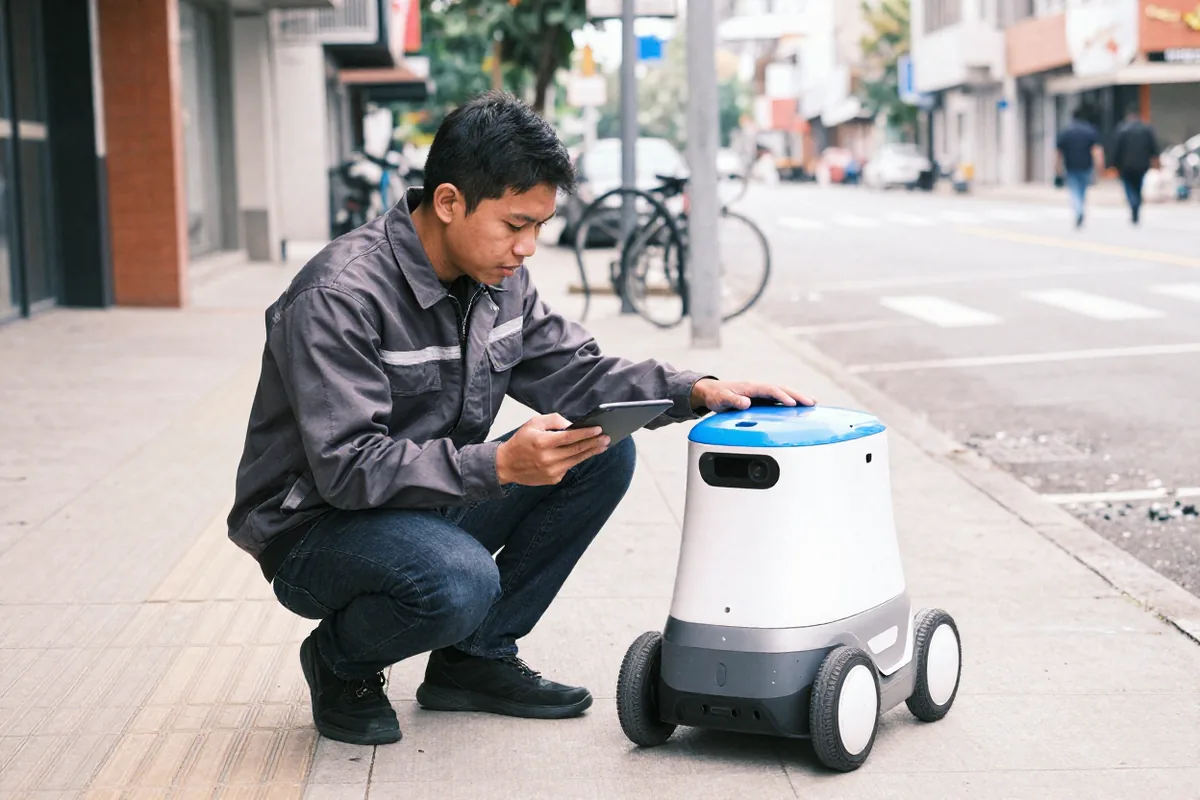
The job, up close
Keep robots moving
Monitor deployed robots, help when they get stuck, and handle field checks, resets, or charging.
- A sample task
- Check on a stuck delivery robot, reset it, and send it back on its route.
- Workplace
- A control room or out in the field
- Tools and kit
- A fleet dashboard, service tablet, and charging equipment
Employers hiring for fleet operations























































Sorted by what an application there is likely worth to you, with a referral lift for employers that pay us a referral fee; your pay is never affected.
Want more context? Line up fleet operations pay at every employer in the pay explorer.
Done field or warehouse work?
Fill in a single profile and any robot training employer can reach you through us. When a company needs someone in a certain city or country, or holding a license or certificate, and you fit, we put you forward, but only after you say yes. It costs nothing.
Written by Yuma Heymans, Founder & CEO of RobotTraining.jobs.
Runs RobotTraining.jobs and AITraining.jobs as founder and CEO, and co-founded HeroHunt.ai, an AI recruitment platform. San Francisco based, and for years focused on how the people who teach robots and AI systems are found, hired and paid.
Robot fleet operations keeps deployed robots running through supervision, recovery, charging and incident response.
This is one of the most accessible on-ramps into embodied-AI work, because it is real, ongoing operations rather than a temporary data-collection gig. Every time you rescue a stuck robot or talk an autonomous vehicle through a construction zone, you are also generating an edge case that engineers feed back into the next model. You are labor and training signal at the same time.
The two halves of the job
Remote monitoring and tele-assist. You sit at a workstation (in an operations center, or increasingly from home) watching a dashboard of live robots. Most of the time the robots drive or roll themselves. Your job is to respond when one raises its hand: a delivery bot blocked by a parked car, a robotaxi that has stopped for a scene it cannot interpret, a service robot that needs a decision. You do not usually pilot the machine down the road frame by frame (that is teleoperation); you give it high-level guidance ('the lane is clear, proceed' or 'reroute around this') and confirm it is safe. This is the growth engine of the category, and the US Senate has documented just how much the AV industry leans on it: a March 2026 investigation by Senator Ed Markey found every major AV company relies on remote assistance operators and none would disclose how often they intervene.
On-street field operations. This is the physical half. You cover a delivery zone on foot, by bike, or by van, and you are the first responder for the robots in it: freeing a bot wedged on a curb, righting one that tipped, swapping or charging batteries, wiping down sensors, and hauling units in and out of service. It is active, outdoor, weather-exposed work. A Serve Robotics Operations Associate posting spells it out plainly: you walk or bike several miles a day, follow strict PPE and phone rules, and do light maintenance like cleaning sensors, all so deliveries finish safely and on time.
What it pays
Read from today's open roles. 237 open roles on RobotTraining.jobs are in robot fleet operations, and 113 of them state an hourly rate. Those rates typically run $20 to $40 an hour, with a median of $25 an hour. They come from individual postings with different duties and locations, not from a category-wide wage survey; the pay explorer and pay report show the full measured sample and its coverage.
| Employer | Open roles | Of those, stating an hourly rate |
|---|---|---|
| All employers | 237 | 113 |
| Tesla | 65 | 9 |
| Amazon Prime Air | 42 | 41 |
| Avride | 12 | 1 |
| TSMG | 33 | 0 |
| Serve Robotics | 16 | 16 |
| Symbotic | 11 | 11 |
| Robot.com | 7 | 7 |
| Dyna Robotics | 7 | 7 |
| Coco Robotics | 4 | 4 |
| Nimble Robotics | 2 | 2 |
An advertised hourly amount is gross compensation, not verified take-home earnings. Salary, equity, benefits, overtime and contractor expenses must be compared separately. We do not infer what a beginner or an expert earns by splitting a pay distribution into tiers.
For accepted-footage or task payments, include setup, recording, upload, review and any rework in your time calculation. An hour of accepted video is a unit of output, not necessarily an hour of labor. There is no guaranteed volume of accepted tasks or paid hours.
Who is hiring and what the shifts look like
The employers cluster into three groups. Delivery-robot companies like Serve Robotics (backed by Uber and NVIDIA) hire operations associates and service technicians in their operating cities ( 16 roles open now). Robotaxi and AV operators, Waymo ( 5 roles open now), Zoox ( 0), Nuro ( 7) and Aurora ( 9), hire remote assistance operators, fleet response specialists, and in-vehicle autonomous-vehicle operators (see the AV and drone operator guide for the in-vehicle side). And humanoid and service-robot makers such as 1X ( 2 roles open now) hire robot service technicians and operators to keep their machines running as they move into commercial pilots.
Expect shift work. Robots run days, nights, and weekends, so fleet teams are staffed around the clock, and overnight or weekend differentials are common. Field roles are physically demanding and outdoor. Remote roles are sedentary but attention-heavy: you may monitor many robots at once and must react fast and correctly when one needs you, because a wrong call on a public road has real consequences.
How to get started, honestly
You do not need a degree or a robotics background for most fleet-ops roles. What employers screen for is dependability, clear communication, a clean record (a driving record for AV roles), and good judgment under mild pressure. A path in:
The honest summary: robot fleet operations is legitimate, growing, and unusually accessible embodied-AI work. It pays a fair hourly wage rather than a fortune, the schedules are real shifts, and the field half is physical. But it puts you inside the deployment loop of the robots that are actually reaching the public, and every stuck-robot rescue you handle is a data point that trains the next generation. Browse current openings across these operators on RobotTraining.jobs, and check the pay explorer to compare fleet-ops rates against the other robot-training roles before you apply.
Common questions
How much do robot fleet operations jobs pay?
Pay is specific to the role, location and payment model, so read the posting. Today 113 of the 237 open fleet operations roles on this site's board state an hourly rate, and those rates typically run $20 to $40 an hour with a median of $25. That is the board's own measured band, not a market-wide wage survey; the pay explorer shows the full sample.
Can you do robot fleet operations from home?
The remote-assist half of the job can be work-from-home or run from an operations center: you monitor a live fleet on a dashboard and step in when a robot needs guidance. The on-street half (physically retrieving, resetting, charging, and cleaning robots) has to be done in the city where the robots are deployed. Even the remote roles are almost always US-based and scheduled on fixed shifts rather than open to a global gig pool.
Do you need a degree or experience to become a robot fleet operator?
No degree is required for most fleet-ops roles. Employers screen for reliability, clear communication, calm judgment under pressure, and (for AV and driving roles) a clean driving record. Experience in customer service, security, delivery driving, warehouse work, or dispatch transfers well. On-street field roles also require the physical ability to walk or bike several miles a day and work outdoors in various weather.
What is the difference between remote assistance and on-street field operations?
Remote assistance (also called tele-assist or fleet response) is screen-based: you watch a fleet and give a stuck or uncertain robot high-level guidance, then confirm it is safe to proceed. It is distinct from teleoperation, where you actively pilot the robot. On-street field operations is hands-on and physical: you go to the robot in person to free it, reset it, swap or charge its battery, clean its sensors, and move it in and out of service. Remote roles tend to pay more; field roles are more physically active.
Which companies hire for robot fleet operations?
Delivery-robot company Serve Robotics hires operations associates and service technicians (16 roles open today). Robotaxi and autonomous-vehicle operators Waymo, Zoox, Nuro, and Aurora hire remote assistance operators, fleet response specialists, and in-vehicle autonomous-vehicle operators. Humanoid and service-robot makers such as 1X hire robot service technicians and operators. On-street roles are concentrated in deployment cities like Los Angeles, Austin, Phoenix, and the Bay Area.
Is robot fleet operations a stable job, or will automation replace it?
The work is growing as more robots reach public streets, and a 2026 US Senate investigation confirmed that every major autonomous-vehicle company still depends heavily on human remote assistance operators. That said, each intervention you handle becomes training data that makes the robots a little more autonomous over time. The most durable, best-paid roles are the skilled, judgment-heavy remote fleet-response positions, so treating an entry-level attendant job as a first step toward those is the smart play.
From the forum
Ask the people doing Fleet Operations work what only they can tell you.
The research behind this page
The figures here come from the same daily read of employers' job boards, and from sourced datasets, that our research reports publish with their method, their sources and a citation for every figure.
- Robot Fleet Operations: Hiring and Pay Market Report
Which employers recruit for Robot Fleet Operations, what rates do they advertise, how crowded is each opening, and who is eligible?
237 open roles on 31 Oct 2026
- Which Robot Training Jobs Draw the Most Applicants
Which robot training roles do job seekers click to apply for, and which ones struggle to find applicants?
536 apply clicks
- Robot Training Pay Structures: Hourly, Per Task or Salary
Do robot training jobs pay hourly, per task or video, or a salary, under what kind of contract, and on what payout schedule?
87% of roles with a pay figure set it per hour
- Requirements in Robot Training Job Postings
What do robot training roles require: a degree, a driver's license, a CDL, a drone certificate, a minimum age, lifting, a background check?
1,150 open roles with a full description read