Robot training work
Robot Teleoperation Jobs
Based on 22 different posted rates, from 11 employers. 59 of these 82 openings give no hourly figure. Advertised USD hourly sample only, not a representative wage survey. Missing rates may bias the result in either direction.
In-depth guide: SO-101 and LeRobot: Teleoperation Practice at Home (2026)
Teleoperation roles open now
Updated 1 Nov 2026, 06:01 UTCSome links here are referral links: when you join an employer through one, RobotTraining.jobs may receive a commission. It costs you nothing, and the employer pays you exactly the same.

Robot Pilot - Customer service (opens the job details)
Keywords Studios · Mexico City, Mexico· 2d agoDetails
 $30/hr
 $35/hr

Founding Robot Operator, US (opens the job details)
Monumental · San Antonio, Texas· 3w agoDetails
 $32–$45/hr

Robot Operator/Technician (Hammond, LA) (opens the job details)
Ambi Robotics · Hammond, LA, United States· 3w agoDetails
$25–$30/hr $18/hr


Robot Operator (opens the job details)
Enact Intelligence · Zürich, Switzerland· 1mo agoDetails

Teleoperator (Nights) (opens the job details)
Cota Robotics · Stockholm, Sweden· 1mo agoDetails

VR Robot Operator and Support Technician (opens the job details)
Tutor Intelligence · Watertown, MA, United States· 1mo agoDetails
$20–$30/hr
Robot Teleoperation Specialist (opens the job details)
Genesis AI · London, United Kingdom· 1mo agoDetails
Remotely pilot a physical robot, through a VR headset, a leader-follower arm, a joystick, or a haptic rig, so its motions become training demonstrations, or step in to guide an autonomous robot when it stalls. This is one entry point into robot training: humanoid labs run teleoperation shifts around the clock, and gaming or VR familiarity often matters more than a degree.
How contested these jobs are
From 4 Oct 2026 to 31 Oct 2026, Robot Teleoperation roles drew 4.5% of the apply clicks on RobotTraining.jobs while making up 7.6% of the time roles were open, so each opening drew 0.59x the attention of an average role. Fewer people chase each opening than in most kinds of work, so a fitting application stands out more easily.
Measured from apply clicks on this site, not from hires. Every kind of work compared.
Teleoperation alerts
Get new Teleoperation roles by email
Each week we gather the latest paid Teleoperation openings from every employer we follow, with the hourly rate where it is posted, and send them in one email. No cost, and you can stop any time.
Only job openings, nothing else. Unsubscribing takes one click.
What teleoperation jobs pay, by job title
In short
Robot Teleoperation. Remotely pilot a physical robot, through a VR headset, a leader-follower arm, a joystick, or a haptic rig, so its motions become training demonstrations, or step in to guide an autonomous robot when it stalls. Typical 2026 pay is $25–$40/hr. The live median is $30/hr, taken from the 11 employers posting a rate for it today. Hiring for it: 45 employers, among them TELUS Digital AI Community, 1X Technologies, Figure AI.
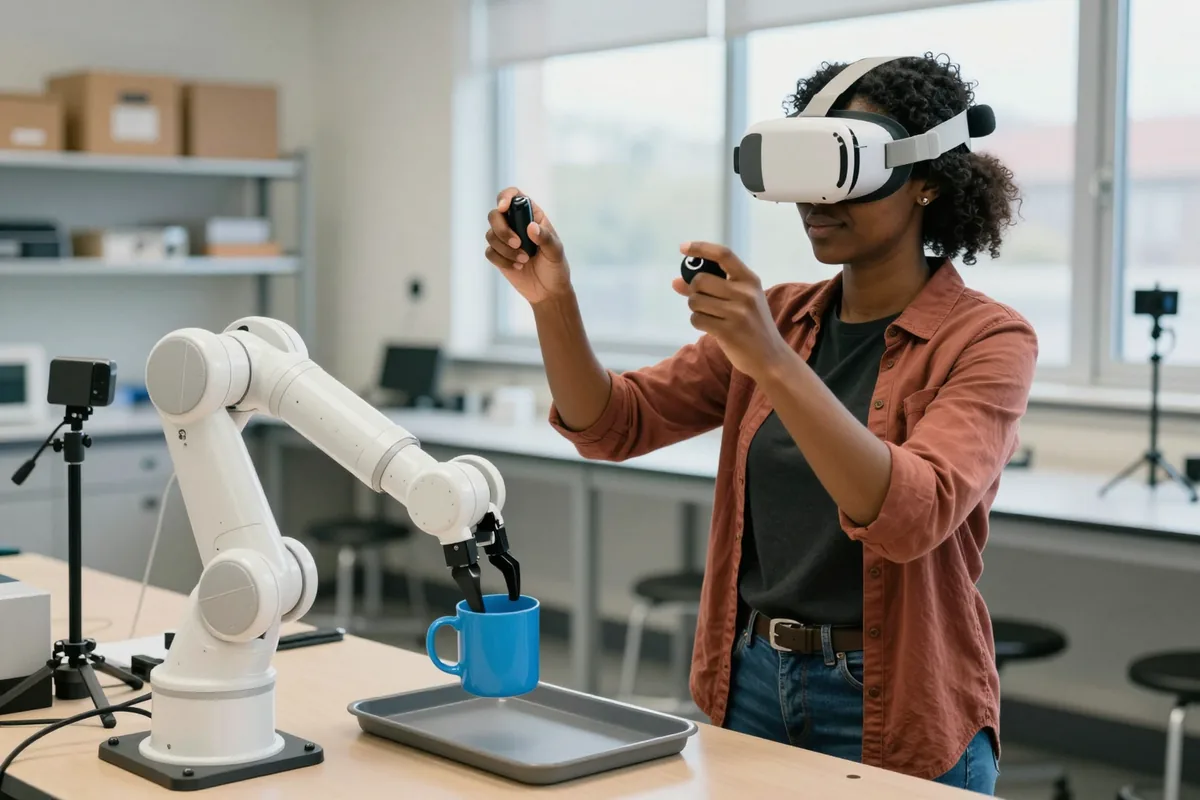
The job, up close
Pilot a robot
Use controllers to guide a real robot through a task. Your movements can become examples the robot learns from.
- A sample task
- Guide a robot to pick up a cup and place it on a shelf.
- Workplace
- A robot lab or a remote-control station
- Tools and kit
- VR controllers, joysticks, or a leader-follower rig
Employers hiring for teleoperation

































Sorted by what an application there is likely worth to you, with a referral lift for employers that pay us a referral fee; your pay is never affected.
Want more context? Line up teleoperation pay at every employer in the pay explorer.
Good with VR, controllers or games?
Fill in a single profile and any robot training employer can reach you through us. When a company needs someone in a certain city or country, or holding a license or certificate, and you fit, we put you forward, but only after you say yes. It costs nothing.
Written by Yuma Heymans, Founder & CEO of RobotTraining.jobs.
Runs RobotTraining.jobs and AITraining.jobs as founder and CEO, and co-founded HeroHunt.ai, an AI recruitment platform. San Francisco based, and for years focused on how the people who teach robots and AI systems are found, hired and paid.
Robot teleoperation means piloting physical hardware through a control interface to perform tasks or collect demonstrations.
This guide covers exactly what the work is, what named employers actually pay (with a rate table you can check against real postings), who is hiring and where, and how to get in. Every figure here links to a real source, and where a number is a market estimate rather than a posted rate, it says so.
What robot teleoperation work actually is
Teleoperation means you control a robot remotely, and the robot copies what you do. There are four common rigs, and which one you use depends on the employer:
- VR headset and hand controllers. You see through the robot's cameras and move its arms and head by moving your own. This is how Apptronik operators pilot the Apollo humanoid and how 1X operators run the NEO robot.
- Leader-follower arms. You move a small "leader" arm on a desk and a full-size robot arm mirrors it exactly. This is the standard rig at manipulation labs like Physical Intelligence and in bimanual ALOHA-style setups.
- Motion-capture suit. You wear a full-body suit (and often a VR headset) and simply do the task yourself while sensors record every joint. Tesla hires people to walk test routes in a mocap suit to train Optimus.
- Joystick or gamepad. Used for wheeled and mobile platforms, and for live-assist work where you take over an autonomous robot that has stalled.
The work splits into two purposes. Most of it is demonstration collection: you repeat a task (folding a shirt, stocking a shelf, prepping food) many times so the robot's model learns from clean, consistent examples. The rest is live assist: an autonomous robot gets confused, and a human operator steps in to guide it through, which also generates a valuable edge-case recording. Teleoperation sits right next to demonstration and data collection and robot fleet operations, and many operators do all three.
Expect a physical, repetitive shift. Operators stand for hours, wear a headset or suit, and hit daily quotas for volume and quality. It is closer to skilled warehouse or studio work than to a desk job.
What robot teleoperation pays
Read from today's open roles. 82 open roles on RobotTraining.jobs are in teleoperation, and 23 of them state an hourly rate. Those rates typically run $25 to $40 an hour, with a median of $30 an hour. They come from individual postings with different duties and locations, not from a category-wide wage survey; the pay explorer and pay report show the full measured sample and its coverage.
| Employer | Open roles | Of those, stating an hourly rate |
|---|---|---|
| All employers | 82 | 23 |
| Figure AI | 7 | 7 |
| HireArt | 6 | 6 |
| Skild AI | 3 | 2 |
| Physical Intelligence | 1 | 1 |
| Ambi Robotics | 1 | 1 |
| Vay | 1 | 1 |
| TSMG | 40 | 0 |
An advertised hourly amount is gross compensation, not verified take-home earnings. Salary, equity, benefits, overtime and contractor expenses must be compared separately. We do not infer what a beginner or an expert earns by splitting a pay distribution into tiers.
For accepted-footage or task payments, include setup, recording, upload, review and any rework in your time calculation. An hour of accepted video is a unit of output, not necessarily an hour of labor. There is no guaranteed volume of accepted tasks or paid hours.
Who is hiring, and where
Humanoid and manipulation labs are one source of teleoperation openings. Compare individual postings rather than assuming that one employer group pays more:
- Figure AI staffs Humanoid Robot Operator shifts in San Jose, Reno and Los Angeles ( 7 teleoperation roles open now).
- 1X Technologies (backed by OpenAI) hires shift-based Operators who pilot the NEO humanoid in VR at its San Carlos, California site ( 2 roles open now).
- Physical Intelligence hires non-engineer Robot Operators in San Francisco to run leader-follower arms through tasks, measured on data volume and quality ( 1 open now).
- Tesla hires Data Collection Operators in Palo Alto and other sites for its Optimus program, with a height requirement since the operator's motion maps to the robot's body ( 34 data collection roles open now).
- Other labs that have hired operators, with the roles each has open on the board now: Skild AI (San Mateo, Pittsburgh, Bengaluru; 4), Apptronik ( 0), Agility Robotics ( 0) and Sanctuary AI ( 0).
How to get started with no degree
Most teleoperation roles do not require a college degree or a robotics background. What they screen for is different:
- Dexterity and consistency. You will repeat precise motions thousands of times. Gaming or VR experience genuinely helps and is often called out in postings.
- Physical stamina. These are standing shifts in a headset or suit. Read the physical requirements before you apply, and take them seriously.
- Availability for shift work. Labs run around the clock, and night shifts often pay a differential. Flexible availability makes you more hireable.
- Reliability. Data quality depends on operators who show up and follow the protocol exactly. That is the single trait every posting is really testing for.
Apply directly on the employer's job board (Greenhouse, Ashby, Lever) rather than through third-party recruiters, especially for direct-hire roles like Apptronik's. Start with the live teleoperation openings on RobotTraining.jobs to compare who is hiring near you, and if the work is new to you, read our beginner's guide to teleoperation first. Expect to begin as an hourly W-2 employee or a 1099 contractor; several labs (like Skild AI) convert reliable contractors to full employees after a training period, and equity or benefits appear at the better-funded labs.
Common questions
Do I need a degree or robotics experience to be a robot teleoperator?
No. Most teleoperation and data-collection operator roles at labs like Figure, 1X, Physical Intelligence, and Tesla screen for dexterity, physical stamina, reliability, and shift availability rather than a degree. Gaming or VR familiarity is often more useful than a technical background, and it is sometimes named directly in the posting.
How much does robot teleoperation actually pay?
Pay is specific to the role, location and payment model, so read the posting. Today 23 of the 82 open teleoperation roles on this site's board state an hourly rate, and those rates typically run $25 to $40 an hour with a median of $30. That is the board's own measured band, not a market-wide wage survey; the pay explorer shows the full sample.
Is this the same as training AI language models?
No. Robot teleoperation is embodied-AI work: you physically pilot a robot (arms, legs, hands) so its motions become training demonstrations, or you assist an autonomous robot that has stalled. It is unrelated to writing prompts, rating text, or evaluating chatbots. The skill it rewards is physical coordination and consistency, not writing.
Can I do robot teleoperation from home?
Mostly not. Teleoperation needs the robot, or its rig, in reach: of the 82 open teleoperation roles on this site's board, 2 is remote. Live-assist work can run from an operations center or a home workstation at a few employers, but most roles are on-site shifts at the lab. Read the posting's location and equipment lines before you apply.
What rig will I actually use?
It depends on the employer. VR headset and hand controllers (Apptronik's Apollo, 1X's NEO), leader-follower arms where a desk arm mirrors a full-size robot arm (Physical Intelligence and ALOHA-style setups), full-body motion-capture suits (Tesla's Optimus program), or a joystick/gamepad for mobile robots and live assist. Postings state which rig the role uses.
Is teleoperation work physically demanding?
Yes. Expect standing shifts of several hours, wearing a headset or suit, repeating precise motions to hit daily volume and quality quotas. Tesla's Optimus role, for example, involves walking a route for over seven hours a day carrying up to 30 pounds. Read the physical requirements in each posting carefully before applying.
Sources
- Tesla pays up to $48/hr for Optimus motion-capture data collection (IoT World Today)
- Figure AI careers: Humanoid Robot Operator roles, $26 to $35/hr by role (Greenhouse board)
- 1X Technologies Operator, Data Collection ($28 to $36/hr + equity) (Ashby)
- Physical Intelligence Robot Operator ($25/hr + benefits) (Ashby)
- Apptronik operator roles, Apollo humanoid VR teleoperation (Greenhouse)
- Skild AI Robot Operator ($25 to $30/hr) (Built In)
- The gig workers training humanoid robots at home, ~$15/hr (MIT Technology Review)
From the forum
Ask the people doing Teleoperation work what only they can tell you.
The research behind this page
The figures here come from the same daily read of employers' job boards, and from sourced datasets, that our research reports publish with their method, their sources and a citation for every figure.
- Robot Teleoperation: Hiring and Pay Market Report
Which employers recruit for Robot Teleoperation, what rates do they advertise, how crowded is each opening, and who is eligible?
82 open roles on 31 Oct 2026
- Which Robot Training Jobs Draw the Most Applicants
Which robot training roles do job seekers click to apply for, and which ones struggle to find applicants?
536 apply clicks
- Robot Training Pay Structures: Hourly, Per Task or Salary
Do robot training jobs pay hourly, per task or video, or a salary, under what kind of contract, and on what payout schedule?
87% of roles with a pay figure set it per hour
- Requirements in Robot Training Job Postings
What do robot training roles require: a degree, a driver's license, a CDL, a drone certificate, a minimum age, lifting, a background check?
1,150 open roles with a full description read