Robot training work
Robot Data Collection Jobs
Based on 27 different posted rates, from 9 employers. 73 of these 128 openings give no hourly figure. Advertised USD hourly sample only, not a representative wage survey. Missing rates may bias the result in either direction.
In-depth guides: SO-101 and LeRobot: Teleoperation Practice at Home (2026), Data Collection Jobs for AI and Robots (2026 Guide)
Demonstration Collection roles open now
Updated 1 Nov 2026, 06:01 UTCSome links here are referral links: when you join an employer through one, RobotTraining.jobs may receive a commission. It costs you nothing, and the employer pays you exactly the same.
 $15–$20 per accepted video-hour
- $20 per accepted video-hour

 $25/hr
 $18–$24/hr

Senior Data Collection Operator (opens the job details)
Genesis AI · Paris, France· 1mo agoDetails


Robotics Data Collection Operator, Shift Lead - Seattle (opens the job details)
Collaborative Robotics · Seattle, United States· 1mo agoDetails
$24–$25/hr

Operator - Data Collection (Swing Shift) (opens the job details)
1X Technologies · San Carlos, CA, United States· 1mo agoDetails
$28–$36/hr • Offers Equity

Data Collection Supervisor (opens the job details)
Nimble Robotics · San Francisco, CA· 2mo agoDetails
$105,000/yr
Produce the physical demonstrations a robot learns from directly: teleoperated demos, kinesthetic teaching (guiding the robot's arms by hand), bimanual ALOHA-style rigs, and provided-hardware capture. On-site studio operators are the backbone of every humanoid data engine, and the work needs dexterity and consistency rather than a technical background.
How contested these jobs are
From 4 Oct 2026 to 31 Oct 2026, Data & Demonstration Collection roles drew 37.8% of the apply clicks on RobotTraining.jobs while making up 9.7% of the time roles were open, so each opening drew 3.88x the attention of an average role. More people chase each opening than in most kinds of work: apply early and match the posting's asks closely.
Measured from apply clicks on this site, not from hires. Every kind of work compared.
Demonstration Collection alerts
Get new Demonstration Collection roles by email
Each week we gather the latest paid Demonstration Collection openings from every employer we follow, with the hourly rate where it is posted, and send them in one email. No cost, and you can stop any time.
Only job openings, nothing else. Unsubscribing takes one click.
What demonstration collection jobs pay, by job title
In short
Data & Demonstration Collection. Produce the physical demonstrations a robot learns from directly: teleoperated demos, kinesthetic teaching (guiding the robot's arms by hand), bimanual ALOHA-style rigs, and provided-hardware capture. Typical 2026 pay is $25–$50/hr. The live median is $30/hr, taken from the 9 employers posting a rate for it today. Hiring for it: 44 employers, among them TELUS Digital AI Community, 1X Technologies, RoboForce.
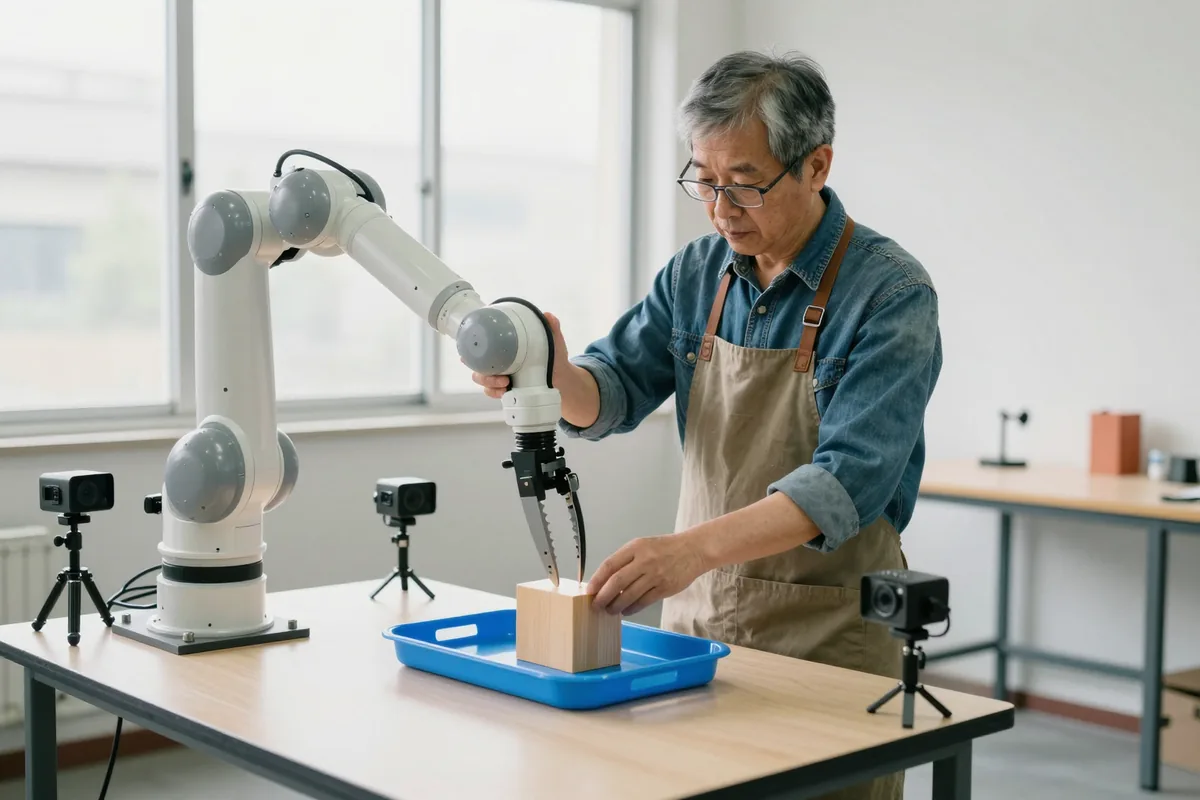
The job, up close
Teach a movement
Repeat physical tasks carefully so a robot can learn the motion, using a teaching rig or demonstration equipment.
- A sample task
- Guide a robot arm through picking up a block and placing it in a tray.
- Workplace
- Usually a lab or capture studio
- Tools and kit
- A teaching arm, grippers, or a motion-capture rig
Employers hiring for demonstration collection
































Sorted by what an application there is likely worth to you, with a referral lift for employers that pay us a referral fee; your pay is never affected.
Want more context? Line up demonstration collection pay at every employer in the pay explorer.
Steady hands and an eye for detail?
Fill in a single profile and any robot training employer can reach you through us. When a company needs someone in a certain city or country, or holding a license or certificate, and you fit, we put you forward, but only after you say yes. It costs nothing.
Written by Yuma Heymans, Founder & CEO of RobotTraining.jobs.
Runs RobotTraining.jobs and AITraining.jobs as founder and CEO, and co-founded HeroHunt.ai, an AI recruitment platform. San Francisco based, and for years focused on how the people who teach robots and AI systems are found, hired and paid.
Data and demonstration collection is the work of producing the physical examples a robot learns from. Modern robots, especially the humanoids being built in 2026, learn manipulation the way a person learns a new kitchen: by watching and copying thousands of correct attempts. Someone has to perform those attempts. That someone is a data or demonstration collection operator, and it is one of the most accessible paid entry points into robotics because it rewards dexterity and consistency far more than a technical degree.
What the work actually is
A demonstration records a task that a robot should learn to perform. The collection setup matters because it determines which observations and actions enter the training data.
- Robot control: an operator guides a robot through a manipulation task using the employer's control interface.
- Instrumented human demonstrations: a person performs the task with a recording device or tool that captures the required motion and visual information.
- Scene preparation and resets: the collector places objects, follows the task script and restores the scene between attempts.
- Review and annotation: the collector checks recordings, marks failed attempts and records deviations from the protocol.
Ask which of these duties the vacancy includes. A role involving hands-on robot operation has different location, equipment and safety requirements from a home-video project. The demonstration learning guide explains how to assess those requirements.
What it pays
Read from today's open roles. 128 open roles on RobotTraining.jobs are in demonstration and data collection, and 55 of them state an hourly rate. Those rates typically run $25 to $50 an hour, with a median of $30 an hour. They come from individual postings with different duties and locations, not from a category-wide wage survey; the pay explorer and pay report show the full measured sample and its coverage.
| Employer | Open roles | Of those, stating an hourly rate |
|---|---|---|
| All employers | 128 | 55 |
| Tesla | 34 | 11 |
| TSMG | 36 | 0 |
| Alignerr | 30 | 30 |
| Collaborative Robotics | 5 | 5 |
| HireArt | 2 | 2 |
| micro1 | 2 | 0 |
| Sunday Robotics | 2 | 2 |
| Dyna Robotics | 1 | 1 |
| RoboForce | 1 | 1 |
| 1X Technologies | 1 | 1 |
An advertised hourly amount is gross compensation, not verified take-home earnings. Salary, equity, benefits, overtime and contractor expenses must be compared separately. We do not infer what a beginner or an expert earns by splitting a pay distribution into tiers.
For accepted-footage or task payments, include setup, recording, upload, review and any rework in your time calculation. An hour of accepted video is a unit of output, not necessarily an hour of labor. There is no guaranteed volume of accepted tasks or paid hours.
Who is hiring, and where
Because the robot has to be in the room, most of this work is on-site and clustered in a few hubs: the San Francisco Bay Area (Dyna Robotics, 1X, Sunday Robotics), Palo Alto and Fremont (Tesla), and Seattle and Santa Clara (Collaborative Robotics). The table above counts what each employer has open today. If you are not near a hub, the more remote-friendly path is egocentric and wearable capture, where you record yourself doing everyday tasks from home. You can compare current rates across every employer on the pay explorer.
Titles worth searching for: Data Collection Operator, Robot Operator, Robot Demonstrator, Robot Pilot, Robot Teleoperator, and Robotics Assistant. Many are posted as contract or fixed-term (Figure's operator roles are contract-to-hire) with a stated path to permanent positions.
What you need, and how to start
You do not need an engineering degree. Employers screen for manual dexterity, patience with repetitive tasks, the discipline to follow a strict data-collection protocol exactly, and physical stamina for standing or seated work across a full shift. Gaming or VR familiarity is a genuine plus for teleop roles. Reliability is the real currency here: a demonstration performed sloppily becomes bad training data, so studios prize operators who hit the same clean motion on take 400 as on take 4.
To get started, pick one or two nearby employers from the table above, read the exact role listing (shift pattern, on-site requirement, contract length), and apply directly. If you want the full walkthrough of the day-to-day and how to prepare, read how demonstration collection works and how to begin. RobotTraining.jobs tracks these openings as they post, so you can filter to demonstration collection roles you can actually do from where you live.
Is it worth it
Compare the offer with the actual working arrangement. For an on-site job, consider the commute, shift length, physical repetition and whether training time is paid. For a contract project, check how work is accepted, whether rejected attempts are paid and whether there is any guaranteed volume.
This work can provide practical experience with robot-data collection, but it does not guarantee progression into an engineering role. Keep a record of the protocols and quality checks you learn without retaining confidential recordings or employer data.
Common questions
How much do robot data and demonstration collection jobs pay?
Pay is specific to the role, location and payment model, so read the posting. Today 55 of the 128 open demonstration collection roles on this site's board state an hourly rate, and those rates typically run $25 to $50 an hour with a median of $30. That is the board's own measured band, not a market-wide wage survey; the pay explorer shows the full sample.
Do I need a degree or coding skills?
No. This is one of the few robotics roles open to workers without an engineering background. Employers screen for manual dexterity, patience with repetitive tasks, the discipline to follow a data-collection protocol exactly, and physical stamina. Gaming or VR familiarity helps for teleoperation rigs but is not required.
Is the work remote or on-site?
Mostly on-site, because the robot has to be physically present: of the 128 open demonstration collection roles on this site's board, 33 are remote. The on-site work clusters in a few hubs such as the San Francisco Bay Area, Palo Alto and Seattle. If you cannot reach a hub, egocentric and wearable capture is the more remote-friendly path, since you record yourself doing tasks from home.
What is the difference between kinesthetic teaching and teleoperation?
In kinesthetic teaching you physically move the robot's arms by hand through a motion while it records the trajectory. In teleoperation you drive the robot from a distance using a leader-follower rig, a VR headset, or controllers. Both produce demonstration episodes; kinesthetic teaching is more hands-on with the hardware, teleoperation is more common on ALOHA-style bimanual rigs and VR setups.
Which companies hire for this, and are the jobs full-time?
Tesla (Optimus) has 34 demonstration collection roles open today, Collaborative Robotics 5, Sunday Robotics 2, Dyna Robotics 1 and 1X Technologies 1, among others. Many roles are contract or fixed-term (Figure's operator roles are contract-to-hire) with a stated path to permanent positions; the larger labs attach benefits and equity.
Sources
- Figure AI careers: Humanoid Robot Operator roles, $26 to $35/hr by role (Greenhouse board)
- 1X Technologies careers: Operator, Data Collection (Ashby board)
- Fortune: Tesla is hiring workers to train its Optimus robot
- AOL: Tesla paying up to $48/hr for motion-capture suit work
- Physical Intelligence careers: Robot Operator, San Francisco (Ashby board)
- ALOHA 2: An Enhanced Low-Cost Hardware for Bimanual Teleoperation (arXiv)
- Mobile ALOHA: learning from 20 to 50 demonstrations (project page)
From the forum
Ask the people doing Demonstration Collection work what only they can tell you.
The research behind this page
The figures here come from the same daily read of employers' job boards, and from sourced datasets, that our research reports publish with their method, their sources and a citation for every figure.
- Data & Demonstration Collection: Hiring and Pay Market Report
Which employers recruit for Data & Demonstration Collection, what rates do they advertise, how crowded is each opening, and who is eligible?
127 open roles on 31 Oct 2026
- Which Robot Training Jobs Draw the Most Applicants
Which robot training roles do job seekers click to apply for, and which ones struggle to find applicants?
536 apply clicks
- Robot Training Pay Structures: Hourly, Per Task or Salary
Do robot training jobs pay hourly, per task or video, or a salary, under what kind of contract, and on what payout schedule?
87% of roles with a pay figure set it per hour
- Requirements in Robot Training Job Postings
What do robot training roles require: a degree, a driver's license, a CDL, a drone certificate, a minimum age, lifting, a background check?
1,150 open roles with a full description read