Guide · 57 min read
How to Get Paid for Remote Robot Training Work (2026)
Written by Yuma Heymans, Founder & CEO of RobotTraining.jobs.
Runs RobotTraining.jobs and AITraining.jobs as founder and CEO, and co-founded HeroHunt.ai, an AI recruitment platform. San Francisco based, and for years focused on how the people who teach robots and AI systems are found, hired and paid.
How each robot and AI training program pays you, and how to move the dollars into your own bank from India, Pakistan, Brazil, the Philippines, Kenya, Nigeria, Mexico or Colombia
A contractor in Lahore and a contractor in Bogotá can finish the same week of home recording for the same US program and end up with very different amounts in their bank accounts. The rate is the same, but the route is not. PayPal does not list Pakistan among the markets it serves - PayPal, and Wise says USD account details are not available to people with an address in Pakistan or Nigeria - Wise. Meanwhile a worker in Colombia paid through Deel can move pesos to a local account in seconds over Colombia's Bre-B instant network - Deel. The work is global, but the plumbing still follows national borders.
That is the first practical question most of our visitors outside the United States ask, usually before they apply: if I record chores, annotate robot video or test AI models for a US company, how does the money actually reach me? The honest answer is that it passes through two or three companies on the way, each with its own fees, exchange rates, identity checks and country rules, and the cheapest route in one country can be closed in the next. Programs publish their pay rates prominently and their payout routes in help-center fine print, so most people find out how they will be paid only after their first week of work.
This guide puts that fine print in one place. It is built on the payout pages of the programs themselves (micro1, Alignerr, Mindrift, Outlier, Claru, RemoExperts, Hub and Mercor), the help centers and fee tables of the services that carry the money (Deel, Payoneer, Wise, PayPal, Grey and Airtm), and official sources from central banks, tax authorities and the IRS, all read on October 30, 2026. You will learn why your pay travels the way it does, how each program pays and how often, what each withdrawal service costs and where it works, what to do in each of our eight largest countries outside the US, what tax forms to expect, and how US contractors handle 1099 income and quarterly tax. The live board behind RobotTraining.jobs lists 81 remote roles today (the remote roles page shows the ones open in your country), and the country sections link to what is open where you live.
Contents
- Why your pay passes through three companies
- How each program pays you
- The withdrawal services: Deel, Payoneer, Wise, PayPal, Grey and Airtm
- Country by country: getting dollars into your bank
- Tax forms when you live outside the United States
- US contractors: getting paid on a 1099, and the tax that comes with it
- When a payout gets stuck
- Payout scams and red flags
- How we researched this guide
- Frequently asked questions
At a glance: the main ways to get your dollars home, scored
Before the detail, here is the field on one table. We scored the six withdrawal routes that the programs in this guide pay into or let you withdraw to on four things that decide whether a route works for you: what it costs to get money to your bank, whether it works in the eight countries this guide covers, how many of the programs in section 2 pay into it, and how fast money arrives. Every score cites the published fact behind it, and all of those facts are linked in the sections below. The final score is the weighted average.
Read it as a map, not a verdict. The program usually chooses the first hop for you (micro1 pays through Deel, Outlier through PayPal, Airtm or ACH), so the table matters most at the second hop, where you choose where the money goes next. A route that ranks low overall can still be the right one in your country: Grey ranks last here because its own page confirms only three of our eight countries, yet in Nigeria, where Wise offers no USD details and PayPal receiving runs only through a local partner, it is one of the few published ways to hold US dollar account details at all.
| # | Route | What it is | Cost to your bank (30%) | Works in our 8 countries (25%) | Programs that pay into it (25%) | Speed (20%) | Final |
|---|---|---|---|---|---|---|---|
| 1 | Wise | Multi-currency account and transfers | 8 - ACH receipts free; Deel charges $0 to send to Wise | 5 - no USD details in Nigeria or Pakistan; in India only through a business account | 7 - Claru, REX, Mercor (some countries), and Deel withdrawals | 7 - India payouts usually arrive in 1 to 2 days | 6.8 |
| 2 | Deel to a local bank | Withdrawal from a Deel contractor balance | 7 - $0 Deel fee to a local bank, Pix free; exchange margin not published | 9 - withdrawal currencies include INR, PKR, BRL, PHP, KES, NGN, MXN and COP | 3 - micro1 among the programs we checked | 7 - Pix and Bre-B instant; others on a "Dynamic ETA" | 6.5 |
| 3 | Payoneer | Receiving account and local withdrawals | 5 - 1.2% to 4% when converting to your currency; $29.95 a year under $6,000 received | 7 - banks in "190+ countries"; Pakistan app withdrawals named | 7 - Mindrift, Claru, REX, and Deel withdrawals | 7 - most withdrawals "within two business days" | 6.4 |
| 4 | PayPal | Wallet used by many programs | 4 - Deel charges 2.5% to send to PayPal; conversion margin "retained" | 6 - not offered in Pakistan; Kenya and Nigeria only through a local partner | 7 - Alignerr, Mindrift, Outlier, and Deel withdrawals | 7 - partner withdrawals in 2 hours to 3 calendar days | 5.9 |
| 5 | Airtm | Digital dollar wallet with a peer-to-peer exchange | - no fee figures published | 6 - says "190" countries; no country list to check | 3 - Outlier | - no timing published | 4.5 |
| 6 | Grey | US dollar account details for Africa and parts of Asia | 6 - 0.8% to receive by ACH, minimum $2, maximum $10 | 4 - lists Nigeria, Kenya and India among its countries | 3 - reached through Deel bank withdrawals | - no timing published | 4.4 |
How the criteria work. Cost to your bank (30%) carries the most weight because it is money you lose on every payout, and it is scored from each service's own published fees; where a margin on the exchange rate exists but is not published, we score lower, because a cost you cannot see is a cost you cannot compare. Works in our 8 countries (25%) counts how many of India, Pakistan, Brazil, the Philippines, Kenya, Nigeria, Mexico and Colombia the service's own pages confirm. Programs that pay into it (25%) counts how many of the eight programs in section 2 pay into the service directly or let you withdraw to it. Speed (20%) uses the timing each service publishes. A dash means the service publishes nothing we could score, and that criterion is left out of its average.
1. Why your pay passes through three companies
Start with the structural question: why does a US company not simply send dollars to your bank? Because paying one person in another country is expensive and legally heavy for the payer. To pay you directly, a program would need to verify your identity, collect the right tax form, screen you against sanctions lists, open banking routes into your country, convert dollars into your currency and answer to your country's foreign exchange rules. Doing that for contributors in dozens of countries, most of whom earn a few hundred dollars a month, makes no sense for a company whose business is training data. So programs hand the whole problem to a specialist and pay that specialist in US dollars, in one batch, in the United States.
Those specialists come in three kinds. Contractor platforms such as Deel sign the contract with you, run identity checks and hold your earnings in a balance you withdraw from: micro1 sends its contracts "via Deel", and its payroll FAQ says payments cannot be processed until the identity check "through Deel" is complete - micro1. Payout processors such as PayPal, Payoneer, Stripe, Tipalti and Airtm take a batch from the program and fan it out to thousands of accounts; Mindrift, for example, pays through two payment partners, Payoneer or Tipalti (PayPal), "depending on the selected withdrawal method" - Mindrift. And some programs run an in-app wallet themselves, as Hub does with withdrawals by PIX, bank transfer or USDC - Hub.
The program pays in US dollars; you choose the last hop where you can
The diagram shows why the same $100 arrives as different amounts. Each arrow is a hop, and each hop can take a cut in two ways: a visible fee (a flat charge or a percentage the service publishes) and an exchange margin, the difference between the rate you get when dollars become rupees, reais or shillings and the mid-market rate banks trade at. Visible fees are easy to compare because services publish them. Exchange margins are harder, because most services describe them without giving a number: Deel says that when you withdraw in another currency "exchange fees and rates will apply" and shows an estimate before you confirm - Deel, and PayPal's Indian user agreement describes a currency conversion fee "applied and retained by us on a base exchange rate" - PayPal India.
Reasoning from those mechanics gives three rules that hold almost everywhere. First, convert once. Every time dollars change currency they lose a margin, so a route that converts dollars to euros inside one service and euros to pesos in another costs more than one conversion straight to your currency. Second, keep dollars as dollars until you need local money, if your country lets you hold a dollar balance, because you then choose when to convert and can compare rates. Third, fewer hops beat cheaper hops: a route with one modest fee often beats a route with three small ones, and every extra company is another identity check that can freeze your money.
Why this matters: on low hourly rates the route is a meaningful share of pay. Claru's Asia postings pay $5 an hour - Claru, so a flat $12 minimum fee on a withdrawal (Deel's charge for sending money to Payoneer, covered in section 3) eats more than two hours of work if you withdraw small amounts. How to apply it: before you take a program's first project, find out which of the three kinds it uses, which withdrawal options it gives you, and what the cheapest route to your own bank costs. Then withdraw in fewer, larger amounts if your route charges a flat fee, and compare the rate shown at confirmation with the mid-market rate on the same day. The next section shows what each program uses.
2. How each program pays you
Every program in this field publishes its pay rate loudly and its payout route quietly, usually in a help-center article or a library page that few applicants read before they start. That is backwards for anyone outside the United States, because the rate is fixed by the program while the route decides how much of it survives. We read each program's own payout pages on October 30, 2026 and quote them below; where the only evidence is second-hand, we say so plainly.
The programs fall into the three groups from section 1. micro1 runs payroll through a contractor platform (Deel). Alignerr, Mindrift, Outlier, Claru, RemoExperts and Mercor pay through payout processors they connect for you (Stripe, PayPal, Payoneer, Tipalti, Airtm, Wise or bank transfer). Hub pays from its own wallet. Each group puts the currency conversion in a different place, which is why the same $100 can arrive as noticeably different amounts of rupees or pesos, and why the table below is worth reading before you apply rather than after.
| Program | How it pays | How often | What its own page says about timing |
|---|---|---|---|
| micro1 | Deel (contract, payroll and identity check) | Twice a month | Work from the 1st to the 15th paid around the 20th; work from the 16th onward around the 5th |
| Alignerr | A connected method "such as Stripe/PayPal" | Weekly | Monday to Sunday cycle, paid by the following Friday |
| Mindrift | Payoneer, or Tipalti (PayPal) | Twice a month | Payouts processed on the 5th and 20th |
| Outlier | PayPal, Airtm or ACH bank transfer | Weekly | Processed on Tuesdays |
| Claru | ACH (US); wire or Wise ( Canada); Wise, Payoneer or a local equivalent (Latin America and Asia) | Every two weeks | First batch typically 7 to 10 days after your first approved capture |
| RemoExperts (REX) | Stripe, Payoneer or Wise | Usually monthly | Some projects pay on shorter cycles |
| Mercor | Stripe Connect, or Wise in some countries | Weekly | Wednesdays, about five days after the work week ends |
| Hub (Minute Data) | PIX, bank transfer or USDC | Any day | Withdraw once recordings are approved; no fees |
How often you are paid matters more than it looks. A weekly payer smooths your cash flow and lets you spot a missing payment within days, while a monthly payer can leave five or six weeks between your first hour of work and your first money. The chart below turns each program's stated schedule into paydays a month (weekly is 52 paydays a year, every two weeks 26, twice a month 24), which is also the number of times a flat withdrawal fee can hit you if you cash out every time.
Read the chart with one caveat: Hub is left out because it lets you withdraw any day, and REX notes that "some projects may have shorter payment cycles". The subsections below give the detail for each program, in the order our readers ask about them most.
2.1 micro1: Deel, twice a month
micro1 is the clearest case of a contractor platform. Its library tells new contractors "You will receive your contract to work with us via Deel", gives a payroll portal at payroll.micro1.ai, and sets two pay periods, "1st to the 15th and 16th to the end of month", with payments "processed within 5 days of the pay period ending" - micro1. Its payroll policy turns that into dates: work from the 1st to the 15th is "paid around the 20th", and work from the 16th to the end of the month around "the 5th of the following month" - micro1 payroll policy. The same policy says payroll runs on Pacific time and that US contractors can wait "+1 business day" because of payment method constraints.
Two details trip people up. First, pay is in US dollars and nothing moves until your identity check is done: the FAQ says "Payments are processed in USD on a bi-monthly basis (twice per month)" and that payments "cannot be processed" until KYC through Deel succeeds - micro1 FAQ. Second, referral bonuses travel separately: "referral payouts are not processed through Deel, but through a separate payout partner" - micro1 referral program. That page does not name the partner. Separately, Whop announced in December 2025 that "micro1 names Whop as its official global payouts partner", saying people on micro1 "can now get paid out instantly through Venmo, PayPal, stablecoins, and local banks worldwide" - Whop. Whop's post does not use the word referral, so treat "Whop handles micro1's referral payouts" as our reading of the two pages together, not something either page states.
Once your pay lands in Deel, the choice is yours: section 3 explains the withdrawal options and what each costs. micro1's own pages do not list which withdrawal methods work in which country, so check the options Deel shows you when you add a withdrawal method. micro1's open roles and current rates are on our micro1 page, which counts 9 open roles today.
2.2 Alignerr: weekly, by Stripe or PayPal
Alignerr, the contractor marketplace run by Labelbox, pays weekly. Its help center says "Our billing cycle runs from Monday to Sunday" and "Payments are made by the following Friday, typically through a payment method connected to Alignerr, such as Stripe/PayPal" - Alignerr. Its robotics recording postings repeat "Weekly payouts" - Alignerr posting.
You will read elsewhere that Alignerr pays through Deel. We found that claim only on third-party comparison sites, and Alignerr's own help article, homepage, FAQ and job postings do not mention Deel at all, so we treat it as unconfirmed and probably out of date. Alignerr's pages also do not say which countries get Stripe and which get PayPal. That matters most in Pakistan, where PayPal is not available (section 4.2): if you apply from there, ask support which method your account will use before you start. Our Alignerr page lists its 41 open robotics roles and the regions it recruits in.
2.3 Mindrift: Payoneer or PayPal through Tipalti
Mindrift, the freelance platform of the AI data company Toloka, pays twice a month through two partners. Its FAQ says trainers are paid through its payment partners, Payoneer or Tipalti (PayPal), "depending on the selected withdrawal method", with cycles from the 1st to the 15th and the 16th to the end of the month and "payouts processed on the 5th and 20th of each month (adjusted for weekends and holidays)" - Mindrift. Tipalti is a payout processor that, in Mindrift's wording, delivers to PayPal.
Its first-person video project for robotics is narrower. The project page offers "$6 per hour", is "Available for residents of Latin America only" and answers the payment question with "You can withdraw the money bi-weekly through Payoneer once your tasks are accepted" - Mindrift egocentric project. So a Brazilian, Mexican or Colombian recording for Mindrift should plan on a Payoneer account. Our first-person capture primer explains the recording work itself. Mindrift publishes no withdrawal minimum or fee of its own; Payoneer's own fees (section 3.2) apply once the money is there. See our Mindrift page for the countries the project names.
2.4 Outlier: PayPal, Airtm or ACH, weekly
Outlier, Scale AI's contributor platform, is mostly text and model-evaluation work rather than robot work, but it is where many of our readers first earn dollars online, so it belongs here. Its FAQ says "we process payments weekly via PayPal, AirTM, or ACH bank transfer" and "Payments are processed weekly on Tuesdays" - Outlier. The same FAQ notes that "Rates vary by expertise, project complexity, and location."
What Outlier does not publish is which method applies in which country. ACH is the US domestic bank network, so it needs a US bank account, which leaves PayPal and Airtm (a digital dollar wallet, section 3.6) as the two methods it names that work without one. Because the method follows your verified location, never set up an account with a friend's address or someone else's PayPal: a mismatch between your identity and the payout account is the fastest way to have a payout frozen (section 7).
2.5 Claru: by region, every two weeks
Claru, which pays people to film household, kitchen, garden and warehouse tasks from their own point of view, publishes the clearest payout terms of any program we track, one posting per region. In the United States: "Pay is $15/hour USD, fixed flat rate, paid via direct deposit (ACH) on a bi-weekly cadence" - Claru US. In Asia, covering India, the Philippines, Indonesia and Vietnam: "$5/hour USD, fixed flat rate, paid via international transfer (Wise, Payoneer, or local equivalent) on a bi-weekly cadence" - Claru Asia. In Latin America: "$6/hour USD of accepted footage, flat rate, paid via international transfer (Wise / Payoneer / local equivalent)", and its FAQ adds that pay is bi-weekly and that the first batch "typically lands" 7 to 10 days after your first approved capture - Claru Latin America.
The practical reading: if you work for Claru outside the US, you need either a Wise or a Payoneer account that works in your country, or a local option Claru offers there. Note the difference in units too: the Latin American household project pays per hour of accepted footage, so footage that fails review is unpaid, while the Asian posting quotes a flat hourly rate. Our Claru page tracks its 16 open capture roles by region, and our guide to data collection jobs explains what first-person capture work involves day to day.
2.6 RemoExperts, Mercor and Hub
RemoExperts (REX) runs a head-camera recording project in six countries alongside its expert evaluation work. Its FAQ says "REX typically pays contributors monthly, but some projects may have shorter payment cycles" and that it "currently supports: Stripe, Payoneer, Wise" - REX. Monthly pay means the longest wait of any program here, so budget for it.
Mercor is the one program that publishes exactly which payout provider each country gets. Its payments guide says it pays hourly contractors "every Wednesday around 12:00 PM PST" for the previous work week, and that it "automatically assigns your payment provider based on your region - you do not choose it" - Mercor. Its supported-countries page says "Payouts use Stripe Connect. Countries marked Wise are paid through Wise instead" - Mercor countries. On that list, India, the Philippines, Nigeria, Mexico and Colombia are paid by Stripe Connect, Brazil by Wise, and Pakistan and Kenya are not supported at all. Its robotics program is different: Mercor says it "pays businesses recurring revenue for wearable-camera video of their team at work" - Mercor robotics, so the country table matters mainly for its other AI training work.
Hub, whose Minute Data app pays people across the Americas to record chores and workplace tasks, runs its own wallet. Its facts page says withdrawals are possible "Any day of the week" by instant PIX in reais, by bank transfer through Dots (one to three business days, in Brazil and abroad) or in USDC on the Base network, with "No fees" and a minimum shown in the app - Hub. The same page explains that the app shows Brazilian users amounts at a fixed 5 BRL per US dollar as "a display convention, not a separate rate", and that some cash-outs are held for a standard security review. Our Hub page carries its current task rates.
Why this matters: the program you choose fixes the first hop, and some first hops simply do not exist in some countries. How to apply it: shortlist programs whose payout method already works where you live (Pakistan rules out PayPal-only and Mercor; Nigeria rules out Wise USD details), and set up that account, in your own name, before your first project ends. The broader picture of how this work is priced (hourly, per task or per accepted hour) is in our research on robot training pay structures.
3. The withdrawal services: Deel, Payoneer, Wise, PayPal, Grey and Airtm
Once a program has paid you, the money sits in a balance somewhere: in Deel, in Payoneer, in PayPal, in an app wallet. Getting it from there to your bank is the second hop, and it is where you usually have a choice. This section covers each service from its own help center and fee table, with what it costs, where it works and the one or two rules that most often catch people. We name these services neutrally: none of them pays us, and no link here is a referral link.
The services differ less in their headline fees than in where they hide the cost. Some charge a visible percentage on the conversion, others charge no visible fee and earn on the exchange rate, and some do both. The only reliable comparison is the amount in your own currency that the service promises on the confirmation screen, set against the mid-market rate for the same day. Keep that test in mind for every service below.
3.1 Deel: one balance, many exits
If a program pays you through Deel, your earnings arrive in a Deel balance in your contract currency (US dollars for micro1), and you withdraw from it. Deel's help center lists the exits: "Deel Card, Wise, Bank Transfer, Instant Card Transfer, Coinbase, Paypal (email on Paypal account must match Deel profile email), Payoneer, Revolut, AstroPay, Digital Currency (USDC and USDT)", with the warning that "not all withdrawal methods are available in all jurisdictions" and the rule that "The recipient's full name on the withdrawal method must match the contractor's profile name" - Deel. Its currency list includes the Indian rupee, Pakistani rupee, Brazilian real, Philippine peso, Kenyan shilling, Nigerian naira, Mexican peso and Colombian peso, although Deel adds that it does not track "whether a contractor in any given country can open an e-wallet balance" - Deel currencies.
The screenshot below, from Deel's own help article on Brazil's Pix, shows the menu you see when you add a withdrawal method, with a provider fee next to each option for an example $1,000 withdrawal. The fees in it come from Deel's example and differ in places from today's fee table, so use it to recognize the screen, not as a price list.
Deel's current fee table, updated October 16, 2026, is the number to trust. It charges $0 for a local bank transfer ("separate provider fees may apply in certain currencies"), $0 for Pix in Brazil, $0 to Wise, Revolut and the Deel Card, $5 for a cross-border withdrawal, $5 to $10 for an international SWIFT transfer, 2% (maximum $15) for an Instant Card Transfer outside the US, 2.5% (minimum $0.25) to PayPal, 1% with a $12 minimum to Payoneer, and 2% plus $1 for a stablecoin transfer - Deel fees. Minimums are $10 for a local bank transfer, $100 for SWIFT, $50 for Payoneer and $5 for most other methods. The chart applies those published fees to a $500 withdrawal.
The chart makes one point loudly: within Deel, the local bank transfer and Wise routes carry no Deel fee, while Payoneer and PayPal cost $12 or more on a typical withdrawal. The catch is the exchange rate. A local bank transfer in rupees or pesos converts your dollars inside Deel, and Deel publishes the estimated rate at confirmation rather than a fixed margin, so compare that figure with the market rate before you accept. Two country exits are worth knowing: in Brazil, Pix withdrawals "are instant" with "no provider fees", only exchange fees if the currency is not BRL - Deel Pix, and in Colombia, Bre-B costs nothing for pesos-to-pesos and "$3.00 + 1.50%" when converting dollars - Deel Bre-B.
On timing, Deel says it uses a "Dynamic ETA" and that most providers, especially banks, "do not process payments on weekends and public holidays" - Deel timing. Why this matters: with Deel the second hop is fully in your hands, and the gap between the cheapest and dearest exit on $500 is $12.50 before exchange rates. How to apply it: add a local bank method in your own currency first, check the rate it quotes, and compare it once with the Wise route; whichever leaves more in your currency is your default.
3.2 Payoneer: receiving accounts and local withdrawals
Payoneer comes up in this guide more than any service except PayPal, because Mindrift, Claru and REX all name it. Its pricing page, last updated January 1, 2026, sets out the costs - Payoneer. Receiving from another Payoneer customer is free; receiving from marketplaces and platforms "Varies by marketplace"; receiving into a local-currency receiving account is free and into a non-local one costs "1% (minimum fee of 1.00 USD or equivalent)". Withdrawals depend on whether money changes currency. A withdrawal to a bank in your own country in a balance already in that country's currency costs 1.50 USD, in a list of supported countries that includes Kenya, Mexico and the Philippines. A withdrawal with currency conversion, which is what turning a dollar balance into rupees, pesos or shillings means, costs 1.2% to 4%, and the page warns that "In some countries, a minimum fee of up to 20.00 USD or equivalent may apply" and that fees depend on "currency corridor". Moving money between your own currency balances costs 0.50%.
There is also an annual fee of 29.95 USD that "Only applies if account receives less than 6,000.00 USD or equivalent in any 12 consecutive months." That clause matters for part-time recorders: someone earning $5 an hour for ten hours a week brings in about $2,600 a year and would pay it, while a steady full-time contributor would not. Our earnings calculator turns an hourly rate and weekly hours into a yearly figure if you want to check where you land. Payoneer's withdrawal page says bank accounts can be linked "in 190+ countries and territories" and that "Most withdrawals typically reach your local account within two business days" - Payoneer withdrawals.
Why this matters: Payoneer's percentage is charged on the conversion to your currency, so on $1,000 the difference between the 1.2% and 4% ends of its range is $28. How to apply it: look up the exact withdrawal fee for your country in your account's fees section before you choose Payoneer over another option, and if you also use Deel, avoid sending Deel money to Payoneer (1%, minimum $12) when a direct local bank withdrawal from Deel is available.
3.3 Wise: account details, where you can get them
Wise is a money transfer service that can also give you account details in other currencies, so a US payer can send you dollars by ordinary US bank transfer. Where it works, it is one of the cheapest routes: Wise says "ACH payments, (direct deposits) in USD are free to receive", while domestic wires and international SWIFT payments carry receiving fees - Wise. Deel charges nothing to withdraw to Wise, which makes Deel to Wise one of the lowest-fee chains in this guide.
The limit is eligibility. Wise's list of places where USD account details are unavailable includes Nigeria and Pakistan, along with Bangladesh, Sri Lanka, Türkiye, the United Arab Emirates and others - Wise. India is a special case: Wise's India page describes receiving with account details for an "Indian business" through a Wise Business account, with incoming money automatically converted to rupees and paid to your Indian bank, an e-FIRC emailed to you, a maximum of 2.5 million rupees and a minimum of 5 US dollars per transaction, and no balances, "due to regulatory reasons" - Wise India. The page does not say whether an individual freelancer qualifies.
The screenshot below, from Mercor's payment guide, shows what a payout through Wise looks like from the receiving end: an email from Wise naming the payer and the amount, with a link to track the transfer.
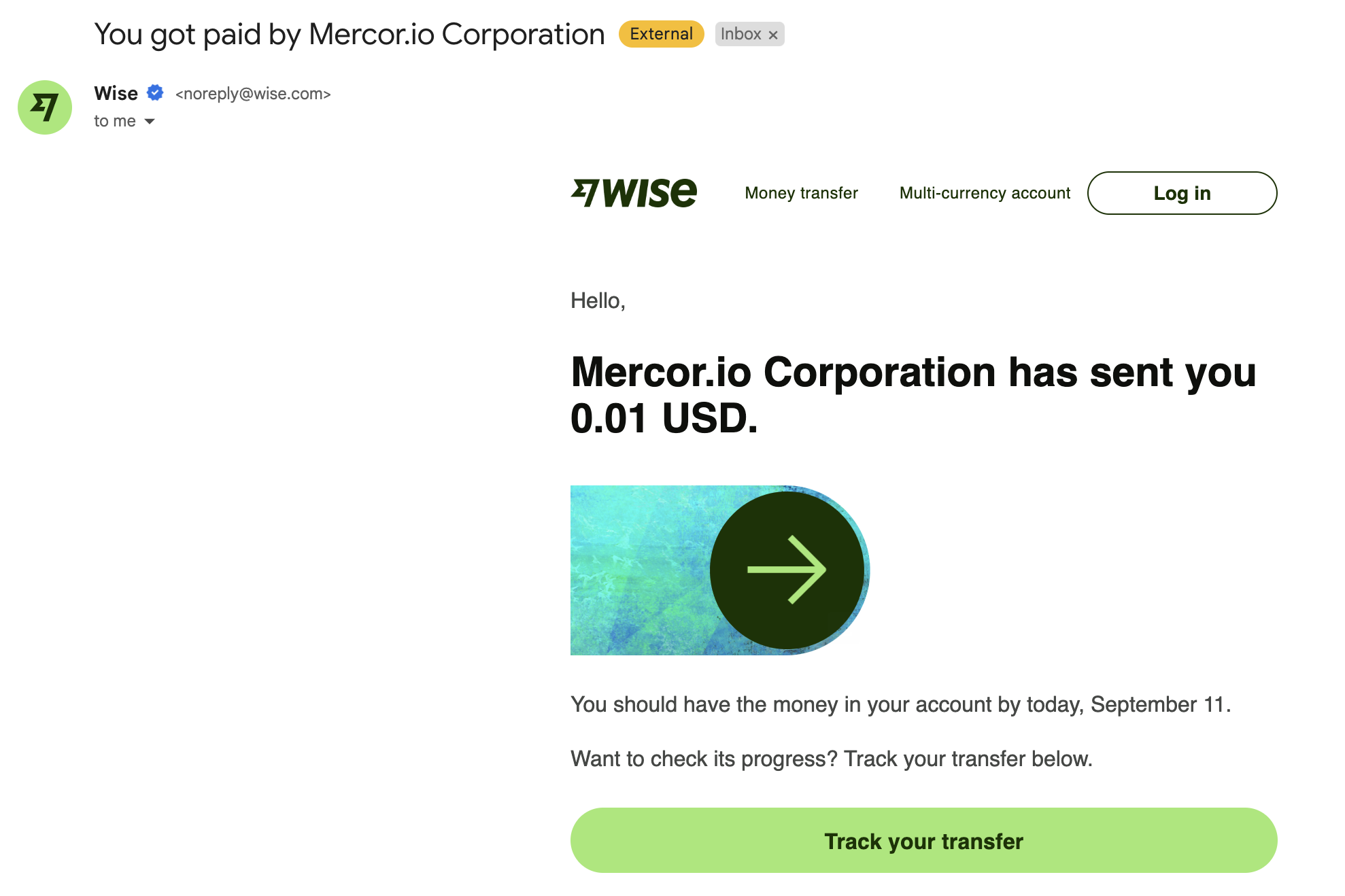
Mercor's guide explains that in the countries it pays through Wise, "Wise emails you after each release" and "you must accept the transfer for funds to reach your bank", with a short sign-up step to claim it if you have no Wise profile yet - Mercor. Why this matters: in the six focus countries where Wise does not exclude USD details, it is often the cheapest way to receive dollars from a program that pays by US bank transfer. How to apply it: check Wise's own eligibility list for your address before you build a plan around it, and if you live in Pakistan or Nigeria, skip to the alternatives in section 4.
3.4 PayPal: widely used, unevenly available
Among the programs in this guide, PayPal is named more often than any other payout method (by Alignerr, Outlier, and Mindrift through Tipalti), and outside robot work DataAnnotation says simply "We send payments via PayPal" - DataAnnotation. It is also the least evenly available. Pakistan does not appear on PayPal's worldwide list of markets at all - PayPal. In Kenya and Nigeria, PayPal works through what it calls third-party partners: its help article says "receiving money with PayPal requires linking your account to a licensed local partner", that "You can withdraw money only up to the available USD balance", and that a withdrawal "takes between 2 hours to 3 calendar days", listing Kenya and Nigeria among the regions served this way - PayPal Kenya.
In the Philippines, PayPal offers a direct route to the GCash e-wallet: "Philippine PayPal customers can withdraw their PayPal balance to their GCash wallet", with a minimum transfer of 500 pesos and funds arriving within hours to a few days depending on the amount - PayPal GCash. In India, PayPal runs as a separate Indian company: its user agreement is with "PayPal Payments Private Limited", requires that "you must be a resident of India", and describes a currency conversion fee "applied and retained by us on a base exchange rate" - PayPal India. Brazil, Mexico and Colombia appear on PayPal's worldwide list, but we did not find PayPal pages describing receiving and withdrawal in those markets, so check what your account shows.
Why this matters: a program that pays only by PayPal is effectively closed to Pakistan and harder to use in Kenya and Nigeria. How to apply it: if your program offers PayPal and something else, compare the PayPal route's conversion with the alternative before you choose, and remember that withdrawing from Deel to PayPal costs 2.5% on top of whatever PayPal charges.
3.5 Grey: US dollar details for Africa and parts of Asia
Grey is a fintech that gives people in a set of countries foreign-currency account details, including US account and routing numbers. Its support page says "Grey is available in Nigeria, Kenya, Ghana, Algeria, Morocco, Egypt, India, Indonesia, and several other countries", and lists the cost of receiving US dollars as "0.8% (minimum $2, maximum $10)" by ACH or FedNow, or a flat $20 by Fedwire - Grey. Receiving naira by bank transfer is free.
Grey's own blog explains how to use it as a Deel withdrawal destination: request a virtual USD account in Grey, then in Deel add a "Bank Transfer" method with "the ACH routing number and account number provided by Grey", making sure "the bank account holder's name on Grey matches the name on your Deel account" - Grey blog. Grey's article points to "Settings" and "Withdraw Methods", while Deel's help center now calls the menu "Finance > Withdrawal methods", so expect slightly different labels. Deel's fee table treats a withdrawal of dollars to a US account from another country as a cross-border transfer, with its $5 fee, so the total on $500 is about $9 ($5 to Deel, $4 to Grey) before any conversion.
Deel's rules on this kind of account are worth reading: it says third-party accounts "are not supported for certain bank transfer methods (all SWIFT and US ACH)" and that individuals can withdraw to an account "under their Profile name" - Deel. An account in your own name at Grey fits that rule; an account in someone else's name does not. Why this matters: for Nigerians, Grey is one of few published ways to hold dollar account details now that Wise excludes Nigeria. How to apply it: check Grey's country list, open the account in exactly the name on your Deel profile, and compare the cost of Grey plus conversion with a direct Deel withdrawal in naira.
3.6 Airtm: a dollar wallet with a peer-to-peer exchange
Airtm matters to our readers mainly because Outlier names it. Its site describes it as "a digital dollar wallet that allows you to receive, send, convert, and withdraw money in USD", claims "500+ ways to withdraw and add funds" through "the P2P network or direct withdrawals", and shows a presence in 190 countries - Airtm. The homepage makes no specific fee claims, and we did not find a published fee table, so the cost of an Airtm withdrawal is whatever the exchange offered at the time shows you.
A peer-to-peer exchange means another user, not a bank, gives you local currency for your dollars, which can work where bank routes are slow or closed. The trade-off is that the rate is set by the market inside the app and varies from offer to offer. How to apply it: if you are paid in Airtm, compare two or three offers against the official rate on the day, cash out to an account in your own name, and keep screenshots of each completed exchange as your record of the income.
4. Country by country: getting dollars into your bank
The services in section 3 behave differently in every country, because each one has to follow local banking and foreign exchange rules and strike its own deals with local banks and wallets. This section takes our eight largest audiences outside the United States one at a time. For each, it covers which of the programs above pay people there, which withdrawal routes the services' own pages confirm, the one or two official rules that matter, and a sensible default route. We only state what an official page or the service's own page says; where we could not confirm something, we say so.
One pattern runs through all eight. Where a country has a fast domestic payment system and a provider plugged into it (Pix in Brazil, Bre-B in Colombia, GCash in the Philippines), the last hop is cheap and instant. Where a country restricts foreign currency or a provider has withdrawn (Pakistan for PayPal, Nigeria and Pakistan for Wise USD details), the route gets longer and costlier. If you are deciding between two programs, the one whose payout route already works cleanly in your country is often worth more than a slightly higher rate.
4.1 India
India has the most options of any country here, and the most paperwork. Claru's Asia postings include India at $5 an hour, paid "via international transfer (Wise, Payoneer, or local equivalent)" every two weeks; Mercor pays India through Stripe Connect; Grey lists India among its countries; and Deel's withdrawal currencies include the Indian rupee. Our board shows 21 roles open to applicants in India today, and our page on egocentric data collection in India covers the home-recording side in detail.
The Indian banks on the receiving end ask questions. Deel warns that IndusInd Bank "may request additional documents" for withdrawals from Deel, which "may result in an additional delay of 10 business days", and that because the money is sent as "Software consultancy/implementation", contractors "should not state that it is a salary payment" - Deel. That is a useful general lesson: when your bank asks what a foreign payment is for, describe it as payment for services you provided as an independent contractor, with your contract and invoices ready, because that is what it is.
Two services work differently in India than elsewhere. Wise's India page describes receiving with account details for Indian businesses, with money converted to rupees automatically, paid to your Indian bank, an e-FIRC (an electronic foreign inward remittance certificate) emailed to you, and no balances held (section 3.3). PayPal operates through its Indian company under an Indian user agreement (section 3.4). Whichever you use, keep every remittance certificate and statement: they are your proof of where the money came from when you file your return or your bank asks.
How to apply it: if your program pays through Deel, start with a rupee bank withdrawal and compare its quoted rate with a Wise or Payoneer route. If it pays by Wise or Payoneer, keep the certificates. For tax, Indian residents report this income on their Indian return, and the rules on how freelance professional income is computed change with your total receipts, so a chartered accountant is worth one consultation before your first full year.
4.2 Pakistan
Pakistan is where the route matters most, because two of the biggest services do not serve it. PayPal does not list Pakistan as a market (section 3.4), Wise does not offer USD account details to Pakistani addresses (section 3.3), and Mercor's supported-countries page lists Pakistan as a place where it "cannot onboard experts or issue contracts". That leaves programs that pay through Deel, Payoneer or a local bank transfer. Deel's withdrawal currencies include the Pakistani rupee, and Payoneer says its partnership with Meezan Bank offers "a real-time withdrawal feature on the Meezan Bank mobile app" to move balances "from USD to PKR" - Payoneer. Our board shows 6 roles open to applicants in Pakistan today.
The State Bank of Pakistan has made receiving freelance export income easier, and its rules reward using a proper freelancer account. Since October 2023, freelancers can open bank accounts "both digitally and physically", with an Exporters' Special Foreign Currency Account opened alongside the rupee account, and "can retain 50% of their export proceeds or USD 5,000/- per month, whichever is higher" in that foreign currency account - State Bank of Pakistan. In April 2026 the SBP removed the need to file a Form R for every payment, replacing it with "a one-time declaration" at account opening, set "a maximum turnaround time of one working day" for processing export receipts, and raised the Form R threshold to "above US$ 25,000" - State Bank of Pakistan.
The practical effect is that a Pakistani contractor who declares freelance IT or data services when opening a freelancer account can keep part of each payment in dollars and convert the rest when they choose. A September 2026 SBP release confirms the framework remains in place: "IT companies and freelancers have been facilitated in opening foreign currency accounts and retaining export proceeds in those accounts" - State Bank of Pakistan.
How to apply it: before applying, check that the program pays by Deel, Payoneer or bank transfer rather than PayPal only. Open a freelancer account with a foreign currency account at your bank and declare the nature of your services. Withdraw from Deel or Payoneer into that account, and keep your contract and payment records. Tax treatment of freelance export income is set by the Federal Board of Revenue and changes with each budget; we could not confirm the current rate from an official page, so ask your bank or a tax adviser which regime applies to you.
4.3 Brazil
Brazil has the smoothest last hop of any country here, thanks to Pix. Deel's Pix withdrawals "are instant" with no provider fees and only exchange fees if the currency is not BRL (section 3.1), and Deel also lists AstroPay among its Brazil options, though its AstroPay article mentions a 1% provider fee where the fee table says 0.75% - Deel AstroPay. Hub pays by Pix any day of the week, Mercor pays Brazil through Wise, Claru's Latin American postings include Brazil, and Mindrift's recording project is open to Latin America with payouts through Payoneer. Our Brazil page lists 59 roles open there today, and our Portuguese guide to getting paid to record tasks covers the programs in your language.
Brazil also has the clearest tax rule for money from abroad. The Receita Federal's carnê-leão covers income of an individual resident in Brazil "recebida de outra pessoa física ou do exterior" (received from another individual or from abroad), and "O imposto deve ser pago até o último dia útil do mês subsequente ao do recebimento do rendimento" (the tax must be paid by the last business day of the month after the month you received the income) - Receita Federal. Its page on what counts lists "os rendimentos recebidos de fontes situadas no exterior" (income received from sources abroad) and explains how foreign amounts are converted - Receita Federal.
That monthly deadline is the thing to plan around. Because the tax is due month by month, not once a year, a Brazilian who works steadily for a US program should record each payout in the month it arrives. How to apply it: withdraw by Pix where your program or Deel allows it, keep the statement for each receipt, and run the carnê-leão each month you receive money (an accountant can set it up once).
4.4 The Philippines
The Philippines is one of the easiest countries for this work. Claru's Asia postings include it at $5 an hour, Alignerr names it among its target regions, and Mercor pays it through Stripe Connect. PayPal offers a direct withdrawal to GCash from 500 pesos (section 3.4), and Deel's Instant Card Transfer works with Philippine peso Visa and Mastercard cards - Deel, at 2% with a $15 maximum outside the US. Our Philippines page shows 68 roles open to Filipino applicants today, many of them home-based.
For tax, the Bureau of Internal Revenue gives self-employed people a simple option. Individuals earning purely from self-employment whose gross receipts stay under the VAT threshold can choose "the eight percent (8%) tax on gross sales or receipts and other non-operating income in excess of Two Hundred Fifty Thousand Pesos" instead of the graduated rates and percentage tax - BIR. The same digest shows the first 250,000 pesos taxed at 0% under the graduated rates.
How to apply it: a PayPal-to-GCash route suits small, frequent payouts, while a direct peso bank withdrawal from Deel or Payoneer suits larger ones. Once your income becomes regular, register with the BIR as self-employed and choose between the 8% option and the graduated rates with the BIR's guidance or a tax adviser, since the choice also decides whether percentage tax applies.
4.5 Kenya
Kenya is open to many programs but closed to some. Mercor lists Kenya as unsupported, and PayPal works there only through a licensed local partner: receiving requires "linking your account to a licensed local partner", you can withdraw "only up to the available USD balance", and withdrawals take "between 2 hours to 3 calendar days" (section 3.4). Deel's withdrawal currencies include the Kenyan shilling, and its Instant Card Transfer works with Kenyan Mastercard cards. Grey also lists Kenya among its countries. Our board shows 6 roles open to applicants in Kenya today.
Kenya's tax authority is explicit that this income is taxable at home. KRA's filing page tells residents to "Declare your employment income together with any additional income", which "includes freelance work, consultancy, online services, or any other income-generating activities", with the filing window for 2025 income running from January 1 to June 30, 2026 - KRA. A KRA article on cross-border work gives the example of "a computer programmer in Kenya offering information technology consultancy services to an offshore company" and concludes the gains "are earned in Kenya" and "therefore taxable in Kenya" - KRA.
How to apply it: prefer programs that pay through Deel or Payoneer, withdraw in shillings to a bank in your name, and keep records for the June filing deadline. If a program pays only by PayPal, link the PayPal account to the local partner service first and do a small test withdrawal before you rely on it.
4.6 Nigeria
Nigeria has the narrowest set of options among these eight countries. Wise excludes Nigerian addresses from USD account details, and PayPal works only through third-party partners there; its Nigerian user agreement says you can receive payments "where available" and tells users to check what services are available "by logging into your PayPal account" - PayPal Nigeria. On the positive side, Mercor pays Nigeria through Stripe Connect, Deel's withdrawal currencies include the naira, and Grey, which lists Nigeria first among its countries, receives naira bank transfers free and US dollar ACH payments for 0.8% (section 3.5). Our board shows 6 roles open to applicants in Nigeria today.
For contractors paid through Deel, that gives two routes worth comparing: a direct naira bank withdrawal from Deel, or a withdrawal of dollars to a Grey USD account in your own name and conversion inside Grey when you choose. The first converts immediately at Deel's quoted rate; the second costs Deel's $5 cross-border fee plus Grey's 0.8% but lets you hold dollars. Which leaves more naira depends on the two rates on the day, so check both once.
We could not confirm the Central Bank of Nigeria's current rules on domiciliary accounts or the new tax law's treatment of foreign freelance income from an official page that loaded, so we do not summarize them here. How to apply it: choose programs that pay through Deel, Stripe or Payoneer rather than PayPal or Wise, open any dollar account in exactly the name on your ID, and get local tax advice once your income is regular.
4.7 Mexico
Mexico is well served. Claru's Latin American postings and Mindrift's recording project include it, Mercor pays it through Stripe Connect, and Hub's app is open across the Americas. Deel's withdrawal currencies include the Mexican peso, its Instant Card Transfer works with Mexican Visa cards in pesos or dollars, and AstroPay is available to contractors in Mexico. Our board shows 19 roles open to applicants in Mexico today, and our Spanish guide to earning money by recording tasks covers the programs in your language.
On tax, the SAT's simplified regime for individuals, RESICO, is limited to people whose income actually received is "menores a 3.5 millones de pesos al año" (less than 3.5 million pesos a year), and residents abroad with a permanent establishment in Mexico cannot use it - SAT. Whether income from a foreign client fits RESICO or the regime for business and professional activities is a question for a contador, because the treatment of foreign-source income differs between the monthly and annual returns.
How to apply it: a peso bank withdrawal from Deel or a Payoneer local withdrawal is usually the simplest route, and Instant Card Transfer is there when you need money the same day at a 2% cost. Register with the SAT once the work becomes regular, and keep each payout's statement.
4.8 Colombia
Colombia has the fastest Deel exit of any country here, through Bre-B, the national instant payment system. Deel's Bre-B withdrawals are free from pesos to pesos and cost "$3.00 + 1.50%" when converting dollars, from a minimum of USD 5 to a maximum of COP 11,500,000 per withdrawal, and Deel presents them as instant withdrawals (section 3.1). AstroPay is also available to Colombian contractors on Deel. Claru's Latin American postings and Mindrift's recording project include Colombia, and Mercor pays it through Stripe Connect. Our board shows 17 roles open to applicants in Colombia today.
For tax, the DIAN's position is that residents "tributan sobre sus rentas y ganancias ocasionales tanto de fuente nacional como de fuente extranjera" (are taxed on their income and occasional gains from both national and foreign sources), and foreign-source income "deberá declararlos en el Formulario 210" (must be declared on Form 210) - DIAN. Colombia also has foreign exchange reporting rules for money coming from abroad, which your bank applies when it receives a transfer; we could not confirm the current requirements for individual service exporters on Banco de la República's own pages.
How to apply it: on Deel, compare Bre-B (fast, $3 plus 1.5% on conversion) with a standard peso bank transfer and with a Wise route on the same amount. Declare the income on Form 210, and keep each withdrawal confirmation as your record.
4.9 What the eight countries have in common
The eight sections above share more than they first appear to. In every country, the cheapest route is the one with the fewest conversions and the fewest companies, and in every country the most common failure is a route that simply does not exist there, discovered after the work is done. The difference between countries is which routes are open, and that is decided by each provider's licensing and banking partnerships rather than by anything you can change, which is why it is worth knowing before you choose a program.
Put side by side, the country sections reduce to a short table. It shows which of the main routes each service's own pages confirm, country by country, and where a route is closed. "None confirmed" does not mean no fast route exists, only that we could not confirm one on a service's own pages, and "Not excluded" means the country is absent from Wise's list of exclusions rather than confirmed by Wise.
| Country | Deel local currency | Wise USD details | PayPal | Fast local exit |
|---|---|---|---|---|
| India | Yes (INR) | Business accounts only | Yes, Indian entity | None confirmed |
| Pakistan | Yes (PKR) | No | No | Payoneer to the Meezan Bank app |
| Brazil | Yes (BRL) | Not excluded | Listed | Pix via Deel or Hub |
| Philippines | Yes (PHP) | Not excluded | Yes, GCash withdrawals | GCash via PayPal |
| Kenya | Yes (KES) | Not excluded | Via local partner | Instant card via Deel |
| Nigeria | Yes (NGN) | No | Via third-party partner | None confirmed |
| Mexico | Yes (MXN) | Not excluded | Listed | Instant card via Deel |
| Colombia | Yes (COP) | Not excluded | Listed | Bre-B via Deel |
The table shows the structural point from section 1 in miniature: no single service is best everywhere, and the cheapest route in one country is closed in the next. Why this matters: your country, not your program, decides most of what you lose between a program's payout and your bank. How to apply it: find your row, rule out the routes marked No, and test the remaining ones with one small payout each before you settle on a default.
5. Tax forms when you live outside the United States
Sooner or later, every US program or payout platform asks a contractor abroad for a tax form, and the request worries people more than it should. The form is almost always the W-8BEN, and it exists to establish that you are a foreign person, not to start a US tax bill. The IRS says to "Give Form W-8 BEN to the withholding agent or payer" if you are a foreign person, and to submit it "when requested by the withholding agent or payer" - IRS. You give it to the program or platform (often inside Deel, Stripe or Payoneer onboarding), not to the IRS.
The reason the form usually means no US tax comes from where the work happens. The IRS says "The place, where the personal services are performed, generally determines the source of the personal service income" - IRS, and that a nonresident alien "generally is subject to U.S. income tax only on income from U.S. sources" - IRS. Recording chores in your own kitchen in Manila or annotating robot video at your desk in Nairobi is work performed outside the United States, so the pay is generally foreign-source income. The picture changes if you do some of the work while physically in the US, which is when a tax adviser earns their fee.
That does not make the money tax-free. It means the tax belongs to your own country, under its rules, and every country in section 4 with an official statement says so: Kenya's KRA names "freelance work, consultancy, online services", Brazil's Receita Federal puts income from abroad under the monthly carnê-leão, Colombia's DIAN taxes residents on foreign-source income, and the Philippines' BIR offers the self-employed an 8% option. The forms differ, but the principle is the same everywhere: you are a self-employed person exporting a service, and you report it at home.
Three habits make this painless. Keep your contract (the Deel or platform agreement that names you as an independent contractor), because banks and tax offices ask for it. Keep a payout log with the date, program, amount in dollars and amount in your currency for every payment, because your home tax is usually figured in local currency at the rate on the day. And keep every bank certificate or statement for foreign receipts (an e-FIRC in India, a bank's export receipt in Pakistan), because they prove the money came from abroad for services. Why this matters: in most of these countries the first year of side income is small enough to fix easily, and the third unrecorded year is not. How to apply it: start the log with your very first payout, and fill in the W-8BEN with your real name, country and address exactly as they appear on your ID.
6. US contractors: getting paid on a 1099, and the tax that comes with it
If you live in the United States, most of the hard problems in this guide disappear and one new one arrives. Moving dollars is easy: US programs pay into a US bank account by ACH direct deposit or through a US PayPal, Stripe or Deel account, with no currency to convert. The new problem is tax. Remote recording, annotation and evaluation work is almost always paid as an independent contractor, which means nobody withholds tax from your pay, and the full bill arrives at once unless you plan for it.
The reason it catches people out is structural. An employee's tax is taken out of every paycheck, so the employee never holds the money that belongs to the government. A contractor holds all of it until they pay it themselves. The money sits in the same account as everything else, it feels like income, and in April it turns out a fifth or more of it was never yours to spend. The fix is simple once you see the mechanics, which the subsections below walk through with the IRS's own figures.
6.1 The forms: W-9 in, 1099-NEC out
When you join a US program as a contractor, it asks for a Form W-9 with your taxpayer identification number, and once a year it may send you a Form 1099-NEC reporting what it paid you. The reporting threshold just changed. The IRS says a payer reports "payments totaling $600 ($2,000 for payments made after December 31, 2025) or more during the calendar year" to a non-employee for services - IRS. So for work paid in 2026, a program that paid you less than $2,000 in the year does not have to send a 1099-NEC at all.
That does not make the money tax-free, and this is the most common misunderstanding we see. The IRS's gig economy page says gig income must be reported even if it is "not reported on an information return form", naming the 1099-K, 1099-MISC, 1099-NEC and W-2 - IRS. Payment apps follow a separate rule: the One Big Beautiful Bill Act reinstated the older Form 1099-K threshold, so a payment platform files one only when your payments exceed "$20,000 and the number of transactions exceeds 200" - IRS. Most robot-training contractors will therefore receive no 1099-K and, below $2,000 a program, no 1099-NEC either, and they still owe tax on every dollar.
6.2 Self-employment tax: the 15.3% nobody withholds
On top of income tax, contractors pay self-employment tax, the contractor's version of Social Security and Medicare. The IRS sets the rate at 15.3%, made up of "12.4% for social security" and "2.9% for Medicare", and it applies once your net earnings from self-employment reach $400 in a year - IRS. The Social Security part stops at a cap: for 2026, the maximum amount of earned income subject to it is $184,500 - IRS Form 1040-ES (2026), far above what side work pays. The same IRS page notes you can deduct "the employer-equivalent portion" of the tax when you work out your adjusted gross income, which softens it slightly.
Here is what that means on a real pay rate. On $15 per accepted hour of home recording, self-employment tax is about $2.30 of every hour before any income tax, and on a $1,000 month of net earnings it is roughly $153, figured on Schedule SE, the form the IRS uses to "figure the tax due on net earnings from self-employment" - IRS. Your income tax comes on top, at whatever bracket your total income lands in. A simple habit is to move a fixed share of each payout, say 25% to 30%, into a separate account the day it arrives; that is our suggestion, not an IRS figure, and your own share depends on your other income and deductions.
6.3 Quarterly estimated tax: who pays and when
Because nothing is withheld, the IRS expects contractors to pay during the year through estimated tax. You generally must pay it for 2026 if you "expect to owe at least $1,000 in tax for 2026, after subtracting your withholding and refundable credits" and your withholding will be less than the smaller of 90% of this year's tax or 100% of last year's - IRS Form 1040-ES (2026). The same form gives the safe harbor for higher earners: if your 2025 adjusted gross income was more than $150,000, substitute 110% for 100%. The IRS says most taxpayers who pay at least those amounts avoid the underpayment penalty, even if they owe more when they file - IRS.
The logic of the safe harbor is worth understanding, because it removes most of the guesswork. You do not need to predict this year's income precisely; you only need to pay, across the four dates, at least the smaller of 90% of this year's tax or 100% of last year's (110% for higher earners). For a contractor whose income is new this year, last year's tax may be small or zero, which makes the first year easier than it looks. The due dates for 2026 are fixed on the form:
| Payment | Covers income earned | Due date |
|---|---|---|
| 1st | January 1 to March 31 | April 15, 2026 |
| 2nd | April 1 to May 31 | June 15, 2026 |
| 3rd | June 1 to August 31 | September 15, 2026 |
| 4th | September 1 to December 31 | January 15, 2027 |
The periods are uneven (the second covers two months, the fourth four), and the IRS's own FAQ lists the same split - IRS. The form adds that you can skip the January payment if you file your 2026 return by February 1, 2027 and pay the balance with it. To pay, the 2026 Form 1040-ES lists your IRS Online Account, IRS Direct Pay (bank transfers "at no cost to you"), a debit or credit card or digital wallet (with a provider fee), and EFTPS - IRS Form 1040-ES (2026).
6.4 A simple system for US contractors
Why this matters: a contractor who earns steadily from one or two programs and pays nothing until April can face a tax bill, plus an underpayment penalty, larger than a month of earnings. How to apply it: open a second savings account and move a fixed share of every payout into it on the day it lands, pay from that account on the four dates above, and keep a spreadsheet of every payout with the program's name, date and amount, since the 1099s will not cover everything. Keep receipts for equipment the work requires (a head strap, a phone mount, a 360 camera a posting makes you buy), because business expenses reduce the net earnings both taxes are figured on.
Two more points save trouble. First, if you also have a job, the 2026 Form 1040-ES notes you can ask your employer to withhold more instead of paying estimates. Second, state income tax is separate and follows each state's own rules, which this guide does not cover. When your contractor income grows past a side income, an enrolled agent or CPA is usually worth the fee.
7. When a payout gets stuck
Most payout problems are not fraud or failure but mismatches: a name that differs by one letter between two accounts, an identity check not finished, a bank that wants to know what a foreign payment is for. They are frustrating because each company in the chain can only see its own part, so the program says it paid, the platform says it sent, and the bank says it never arrived. Knowing the common causes in advance prevents most of them and shortens the rest.
The rules come straight from the services' own pages. Deel requires that "The recipient's full name on the withdrawal method must match the contractor's profile name", and for PayPal that the "email on Paypal account must match Deel profile email" - Deel. micro1 will not process pay at all until your identity check is complete. Mercor's guide warns that Stripe "enforces a 7‑day holding period on your first payout" - Mercor, and that a payout sent to wrong bank details bounces back and is retried within 10 to 15 business days, which "cannot be expedited" - Mercor. Hub notes that some cash-outs "are held for a standard review" before release, and Deel reminds contractors that banks "do not process payments on weekends and public holidays".
| Problem | Usual cause | What to do |
|---|---|---|
| Payout rejected | Name on the receiving account differs from your profile | Make every account match the name on your ID, exactly |
| Pay not processed | Identity check (KYC) unfinished | Finish verification in the platform before the period ends |
| First payout late | A first-payout hold, such as Stripe's 7 days | Expect it once; later payouts run on schedule |
| Bank asks questions | Foreign receipt with no stated purpose | Show your contract and invoices; describe it as payment for services |
| Money "lost" in transit | Weekend, holiday or a bounced transfer being retried | Wait for the platform's stated window, then open a ticket with the transfer ID |
The table reads as one rule: set everything up in your own legal name, before the first pay date. Every item on it is either a name or identity mismatch or a timing effect, and none of them is solved by contacting the program on payday. Why this matters: a frozen or bounced first payout can take two or three weeks to clear, which for someone earning a few hundred dollars a month is a serious gap. How to apply it: the week you are accepted, complete the platform's identity check, add a withdrawal method in your own name, make a small test withdrawal if the platform allows one, and save the transfer reference of every payout so support can trace it.
A separate cause of stuck money is sending it somewhere the platform does not allow. Deel says third-party accounts "are not supported for certain bank transfer methods (all SWIFT and US ACH)" and that individuals withdraw to an account "under their Profile name". A relative's account, a friend's PayPal or an account bought from someone else will fail at best and get your account closed at worst. If a route is not open to you in your own name, the answer is a different route from section 4, not a borrowed one.
8. Payout scams and red flags
Anywhere money crosses borders through apps, scammers follow, and AI training work attracts them because it is new, paid per task and done remotely. The pattern that matters most for payouts is the fake withdrawal fee: an app or "recruiter" shows you a balance of earnings and then asks you to pay something to release it. The US Federal Trade Commission puts it plainly: "Someone telling you to pay money to get the money you've supposedly earned is a sure sign of a scam" - FTC.
The scale is real. In the first half of 2024 alone, the FTC counted about 20,000 reports of these task scams, against about 5,000 in all of 2023, and reported job scam losses topping $220 million; it also noted that "crypto is the currency of choice for these scams". The real programs in this guide work in the opposite direction: they pay you, through a named platform, on a published schedule, and the only fees are the published withdrawal fees of the service you choose, deducted from what you withdraw, never paid in advance.
| Red flag | What it looks like |
|---|---|
| Pay to withdraw | A "release fee", "tax" or "unlock deposit" before you can cash out |
| Unknown payout app | A wallet or exchange the program's own help pages do not name |
| Borrowed accounts | An offer to receive your pay into someone else's account or sell you a verified one |
| Crypto deposits | Any request to send cryptocurrency to keep earnings or unlock tasks |
| Recruiter on chat apps | A job offered by text, WhatsApp or Telegram, with pay through a private channel |
The test is the direction of the money and the name of the route. If a program's own help center names the payout method, and the method only ever takes its fee out of money you are withdrawing, the route is normal. If anyone asks you to pay first, or to use a payout app the program never mentions, stop. How to apply it: check every program against its own website before you share identity documents, and use our scam checker to test an offer you are unsure of. Reports from Kenya, Nigeria, India and Pakistan go to your national cybercrime or consumer protection body as well as to the platform being impersonated.
9. How we researched this guide
Every statement about how a program pays comes from that program's own payout page, help center, library or job posting, read on October 30, 2026, and every statement about a withdrawal service comes from that service's own help center, fee page or user agreement, read the same day. Country rules come from official sources (the State Bank of Pakistan, the Receita Federal, the Bureau of Internal Revenue, the Kenya Revenue Authority, the SAT and the DIAN), and the US section from IRS pages and the 2026 Form 1040-ES. Where the only evidence was second-hand, as with the claim that Alignerr pays through Deel, we say so and do not rely on it. Where an official site would not load for us (India's Income Tax Department, the Central Bank of Nigeria, Mexico's SAT legal articles), we left the point out rather than repeat it from a third party.
The open-role counts in this guide are read from the RobotTraining.jobs board each time the page loads, and each opens the list it counts. The scores in the table at the top are our judgment, applied with the same criteria to every route and justified by a published fact in every cell. Fees, eligibility and schedules change, and several services say so on the pages we cite; the methodology page explains how the board itself is maintained.
Two disclosures matter for how you read this guide. Some employers named here, micro1 among them, pay RobotTraining.jobs a referral commission when someone joins through our apply links, which never changes what they pay you; our referral disclosure explains how that works. None of the payment services in this guide (Deel, Payoneer, Wise, PayPal, Grey, Airtm, Stripe or any other) pays us anything, no link to them here is a referral link, and they are scored with the same criteria and the same kind of evidence.
10. Frequently asked questions
How do I withdraw money from Deel to my bank?
In Deel, go to Finance, then Withdrawal methods, add a method in your own name (a bank transfer in your local currency is the usual first choice), then withdraw from your balance. Deel charges no fee for a local bank transfer and shows the exchange rate before you confirm; Wise and Revolut are also free from Deel, Payoneer costs 1% with a $12 minimum and PayPal 2.5%. In Brazil, Pix is free and instant, and in Colombia, Bre-B is free from pesos to pesos.
Is Payoneer or Wise better for receiving dollars from AI training work?
It depends on your country. Wise is cheaper where it works, since US ACH payments are free to receive, but it does not offer USD account details to people in Nigeria or Pakistan and in India it works through business accounts. Payoneer works in more places, including Pakistan through the Meezan Bank app, but charges 1.2% to 4% to convert and withdraw, plus a 29.95 USD annual fee if you receive less than 6,000 USD in 12 months.
Can I use PayPal for AI or robot training work in Pakistan?
No. Pakistan is not on PayPal's list of markets, so programs that pay only by PayPal cannot pay you there. Look for programs that pay through Deel or Payoneer, which can reach Pakistani bank accounts, and use a freelancer account with a foreign currency account so you can keep part of each payment in dollars under State Bank of Pakistan rules.
How does micro1 pay contractors?
micro1 pays through Deel, in US dollars, twice a month: work from the 1st to the 15th is paid around the 20th, and work from the 16th to the end of the month around the 5th of the next month. You must complete Deel's identity check before any payment, and referral bonuses are paid through a separate payout partner rather than Deel.
How does Outlier pay workers outside the US?
Outlier's FAQ says it pays weekly, on Tuesdays, by PayPal, Airtm or ACH bank transfer, with rates that vary by location. ACH needs a US bank account, which leaves PayPal and Airtm, the two other methods it names, for contributors abroad. Outlier does not publish which country gets which method.
Does Alignerr pay through Deel?
Not according to Alignerr's own pages. Its help center says it pays by the Friday after each Monday to Sunday cycle, "typically through a payment method connected to Alignerr, such as Stripe/PayPal". The Deel claim appears on third-party sites only, and we treat it as unconfirmed.
Do I pay US tax on AI training work I do outside the US?
Generally not. The IRS says the place where services are performed generally determines the source of the income, and nonresident aliens are generally taxed only on US-source income, so work done in your own country is usually foreign-source. You will be asked for a W-8BEN, which goes to the payer, not the IRS. You do owe tax in your own country under its rules.
Do US contractors have to pay quarterly taxes on 1099 income?
Usually yes, once you expect to owe $1,000 or more for the year. For 2026 the due dates are April 15, June 15 and September 15, 2026, and January 15, 2027. Contractors also owe 15.3% self-employment tax once net earnings reach $400, and the income is taxable even when no 1099 arrives, which for 2026 payments happens below $2,000 from one payer.
Why did my first payout take longer than later ones?
First payouts often wait on identity checks and holds that later ones skip. Deel will not release pay until verification is complete, Stripe holds a first payout for 7 days on some platforms, banks may ask what a new foreign payment is for, and transfers do not move on weekends or public holidays. Setting up your withdrawal method in your own name before the first pay date avoids most delays.
This guide reflects program payout pages, payment service fee tables and official rules as read on October 30, 2026; open-role counts are read live from the board. Fees, eligibility and schedules change, and none of this is tax or legal advice, so confirm the current terms on each service's own page and with a local tax adviser before you rely on them.